For over a quarter of a century, the core interface of the internet looked exactly the same. You went to Google, saw a clean white page, and encountered a single, narrow rectangle. How you used it was simple. You compressed a complex, real-world problem into a handful of keywords. If a user needed a lawyer, they typed phrase fragments like “divorce attorney near me” or “car accident lawyer medical bills” into that box, hit enter, and combed through a list of blue links.
With Google’s latest major updates, that 25-year-old habit is being shaken up.
Google has completely overhauled its core interface to prioritize what it calls AI Mode. Driven behind the scenes by its newly-released Gemini 3.5 Flash model, search is shifting from an index of websites into a conversational assistant.
The way clients look for legal representation is changing right now. If your website is still optimized exclusively for the keyword matching of the past, your firm may become completely invisible to the modern searcher.
The Biggest Redesign in 25 Years: The Intelligent Search Box
The centerpiece of this update is a total reimagining of the standard Google search bar. Google is calling it the Intelligent Search Box.
Dynamic Expansion for Long Prompts
When a user begins typing a query, the search box no longer sits statically on the page. Instead, it dynamically expands to give the user a large, canvas-like space to describe their situation in full, natural language. Google is actively training people to stop using short keywords and instead type out entire paragraphs of context.
A user does not need to search for a clipped term like “wrongful termination lawyer.” Instead, they can type a highly detailed narrative: “I was fired yesterday from my management job after bringing up safety issues to HR. I have copies of my emails and my employee handbook. Do I have a case in Texas, and what should my next step be?”
Multimodal Uploads Directly in the Search Bar
The new search box isn’t restricted to plain text. It now features an interface that allows users to upload images, videos, PDF files, and even active Chrome tabs alongside their written question.
A potential client can take a photo of an insurance settlement offer, upload a PDF of a business contract, or attach a police accident report directly into the Google search bar. They can then ask the AI to analyze the situation and suggest a local legal specialist who handles that exact scenario.
Protect and Verify Your Law Firm’s Brand Presence
Seamless Transition into Conversational AI Mode
Once the initial results are generated via an AI Overview, searchers no longer have to start a brand new query if they need more clarity. The search box allows users to ask fluid follow-up questions right from the initial overview, pulling them into a continuous, conversational back-and-forth.
Google maintains the context of the entire conversation. As the user digs deeper into their legal question, the supporting links and firm citations suggested by the AI update in real time to match the growing nuance of the discussion.
Under the Hood: How Query Fan-Out Changes Legal Research
To understand why some SEO tactics are failing in AI Mode, you have to understand the underlying mechanics of how Google processes these expanded questions.

In the old model, Google took your keyword string and matched it against an index of web pages that contained those exact words. In AI Mode, Google utilizes a technique called Query Fan-Out.
When a user types a complex paragraph into the Intelligent Search Box, the Gemini engine does not perform a single search. Instead, it dissects the paragraph and simultaneously executes dozens of targeted sub-searches across the web. It analyzes statutory laws, localized legal definitions, court jurisdictions, and firm reputations all at once. It then synthesizes those fragments into a single, cohesive response.
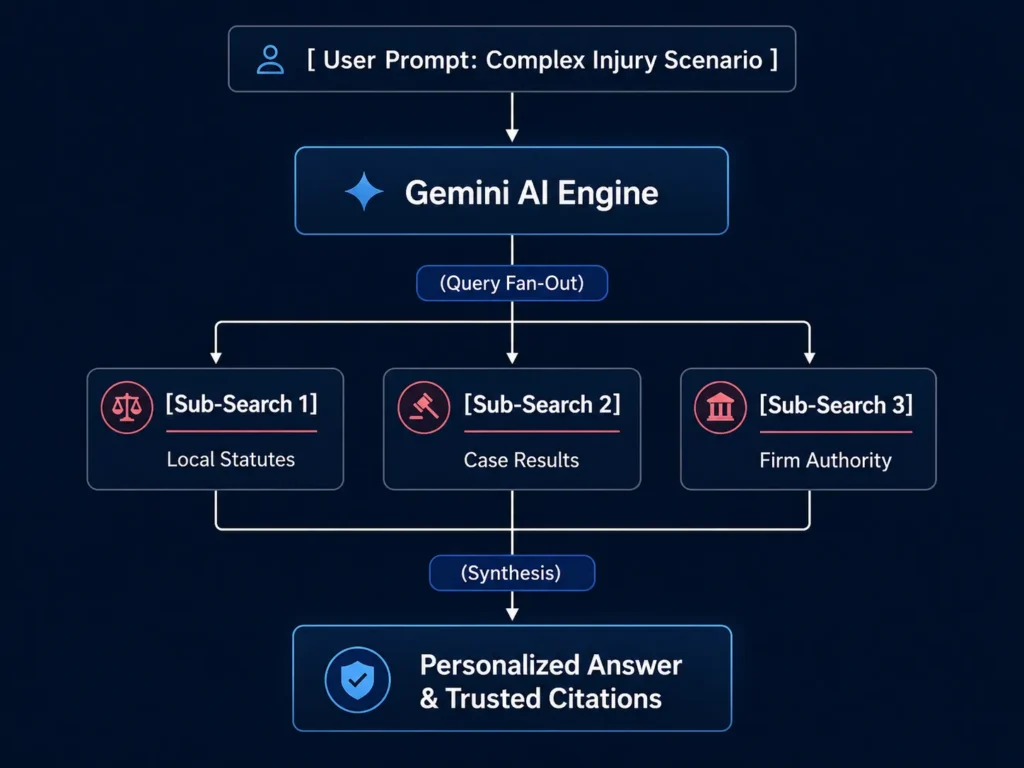
For example, if a user provides a narrative about a truck accident on a specific local highway, the Query Fan-Out mechanism will simultaneously search for commercial trucking regulations in that state, accident statistics for that specific highway intersection, and local law firms with verified verdicts involving commercial carriers.
The AI is acting as a researcher. It is looking for a digital consensus across multiple platforms before it decides which law firms are worthy of a citation. If your website only contains a generic page about truck accidents, the fan-out process will pass right over you in favor of a site that offers deep, scenario-specific data.
The Shift in User Habits: A Data Comparison
The practical reality of AI Mode is that it fundamentally changes how long users interact with search and where they look for answers. Industry data collected over the past year highlights a stark contrast between traditional search behavior and AI Mode interactions.
| Metric | Traditional Google Search | Google AI Search Mode |
| Average Session Duration | 2 to 3 minutes | 11 minutes |
| Primary Interaction Style | Quick keyword lookup | Multi-turn conversational dialogue |
| Top 10 Organic Overlap | 100% of standard links | Only 32% match top 10 organic results |
| Average Links Provided | 10 standard blue links | 12.6 integrated citations per answer |
| User Search Intent | Navigation or quick lookup | Deep research and scenario analysis |
Making Your Firm the Definitive Source of Truth
This data reveals an important truth. The links that rank number one in traditional search results are only appearing in AI Mode sidebars about one-third of the time. The AI model is actively looking for different indicators of quality than the classic organic algorithm. It prioritizes depth, structural clarity, and unique information gain over simple keyword optimization.
The Arrival of the Agentic Search Layer
The evolution of AI Mode goes beyond synthesizing text. We are now entering the era of Search Agents. These are autonomous digital systems operating right inside the search engine that can actively monitor information and perform tasks in the background on behalf of the user.
Google is rolling out specialized Information Agents. A user can set up an agent to track a developing legal situation, a specific corporate entity, or local regulatory changes.
For example, a business client can instruct their agent: “Monitor all new filings and local news regarding zoning changes in our district, and notify me the instant a conflict arises.” The agent will continuously scan blogs, news outlets, and court records 24/7, providing the user with synthesized updates and recommending local legal teams when a conflict is detected.
Furthermore, with user permission, these agents can access personal intelligence data from a user’s Google Calendar, Gmail, and location history to deliver highly hyper-personalized recommendations. If an agent recognizes from a user’s calendar that they are dealing with a local business transition, it will prioritize local corporate attorneys who possess verified entity records in the immediate geographic area.
What This Change Means for Your Law Firm’s Traffic
This conversational interface design is intentionally built to keep users on the search page longer. As a result, the legal marketing community must prepare for a shift in how performance metrics are evaluated.
The Reality of Traffic Volume
With the Intelligent Search Box providing comprehensive answers right away, raw informational traffic to standard law firm websites is shifting. If a user just wants a general understanding of a legal timeline or a definition of a statutory term, they can get it completely within AI Mode without ever clicking through to a website. Law firms will likely notice a decline in raw, top-of-funnel blog traffic.
The High-Intent Conversion Opportunity
While total click volume may shift, the intent of the visitors who do click through to your website is drastically higher. The users who navigate from a deep, multi-step conversation in AI Mode to your specific landing page are no longer just browsing. They have already used the search box to analyze their problem, review citations, and verify that your firm handles their exact scenario.
When these users land on your site, they are highly qualified and far closer to making a hiring decision. The goal of your website is no longer to capture massive amounts of casual traffic, but to convert these deeply vetted, high-intent leads.
The Legal Optimization Checklist for AI Mode Visibility
To ensure your law firm is selected as a trusted source by Gemini’s Query Fan-Out mechanism, you must update your optimization playbook. Your site must move away from generic text and focus heavily on information gain and technical clarity.
- Structure Data for the Knowledge Graph: AI search relies on entity verification. Implement meticulous Schema Markup across your entire site. Use LegalService, Attorney, and FAQ schema to explicitly map out your firm attributes, attorney bar credentials, and local service areas in a language the machine understands perfectly.
- Consolidate Brand and Reputation Signals: Search agents analyze third-party reviews and legal directories to assess sentiment. Ensure your firm’s name, physical office address, and phone number are perfectly identical across the State Bar, local news outlets, and your own digital assets. A fragmented footprint leads to an immediate algorithmic penalty.
- Build Dedicated Case Result Hubs: AI models struggle with abstract claims of excellence. They require verifiable data. Create highly structured case result sections that break down the specific parameters of your victories, including the accident dynamics, the insurance challenges, and the local venue. This provides the proprietary data that AI Mode is forced to cite when users ask hyper-specific questions.
Read More: How to Create Helpful Legal Content for Search Engines
How Civille Optimizes Your Firm for the AI Mode Reality
AI models do not guess which law firms to recommend in these deep, multi-step conversations. They rely heavily on data clarity, structural technical standards, and real-world consensus.
At Civille, we build authority engines designed to feed Google’s new interface exactly what it needs to choose your firm. Our optimization strategy focuses on three critical areas.
1. Scenario-Based Content for Complex Queries
Because users are writing full paragraphs instead of short keywords, generic website content will no longer rank. We optimize your practice area pages with highly specific, scenario-based insights and robust FAQ modules. When a user inputs a complicated, multipart situation into the expanded search box, your content matches the specific parameters the AI is trying to solve.
2. Advanced Schema Implementation
We use precise behind-the-scenes code, including Legal Service, Attorney, and FAQ Schema. This serves as a direct translator for the search engine. It organizes your credentials, location, and practice areas into a structured format that the Gemini algorithm can read and verify with perfect confidence, increasing the likelihood that your firm is cited in the conversational loop.
3. Uncompromised Technical Speed
The new conversational interface requires lightning-fast verification. An AI assistant will not route a high-stakes user to a sluggish, poorly coded website. We design our platforms with clean architecture so that even as your pages grow to include comprehensive case results and deep knowledge hubs, they load instantly. Speed is a primary indicator of operational reliability for both humans and machines.
The Future-Proof Mindset
Google’s overhaul of the search box is a clear signal of where the internet is heading. Search is no longer just a matching game between keywords and text. It is an ongoing conversation based on context, trust, and real-world expertise.
Firms that continue to rely on outdated, flat web structures risk losing their digital footprint. Conversely, firms that adapt their websites to serve as structured authority platforms will capture the most valuable cases in their market.
The rules have changed, but the opportunity has never been larger. We can help you translate your real-world legal success into digital authority that commands the attention of Google’s new interface. It is time to talk to Civille.