Google has officially completed the global rollout of its dedicated Search Generative AI control, along with new Generative AI performance reports in Google Search Console. Learn how this may affect your firm.
For the first time, site owners have an explicit switch at their disposal: you can decide whether your website’s content may feed Google’s generative search features, including AI Overviews, the conversational AI Mode, and Discover, while retaining standard indexing in traditional organic search results.
For managing partners, in-house marketing directors, and firm ethics committees, this switch looks like a tempting panic button.
In a profession regulated by strict state bar advertising rules, confidentiality mandates, and sensitivity to professional liability, the idea of keeping a law firm’s content out of generative AI has some appeal. For months, attorneys have watched artificial intelligence synthesize hallucinated legal answers, misstate local statutory limits, and scrape proprietary analyses without attribution. Flipping the switch to “opt out” seems like an easy way to insulate a law firm from regulatory trouble.
That instinct, although understandable, is one of the most dangerous strategic mistakes a legal practice can make in 2026.
Opting out of Google’s generative search layer doesn’t protect your law firm from AI. It merely ensures that your law firm becomes invisible in the primary interface that modern clients use to find legal representation. To make an informed decision, law firm leaders must examine what this switch actually does, assess the real risks across different firm sizes, and understand how to navigate the significant reporting blind spots in Google Search Console.
What Google’s Search Generative AI Control Actually Does
To evaluate this switch, you must understand the technical separation that Google has built into Search Console.
Indexing used to be all-or-nothing. Let Googlebot in and your pages showed up everywhere. You got blue links, featured snippets, image search. Block it with robots.txt or a noindex tag and you vanished from Google altogether. There was no middle setting.
The new Search Generative AI control separates standard search indexing from generative synthesis:
- When enabled (default): Your pages still appear in normal Google search results, and Gemini is free to read, summarize, and cite them across AI Overviews, AI Mode, and Discover.
- When opted out: Google still indexes and ranks your pages in regular organic search with the classic blue links. What changes is the AI side. Your domain can no longer be pulled as a source, grounding reference, or citation in AI Overviews or AI Search Mode.
Google built the switch after antitrust scrutiny and copyright pushback from publishers worldwide, who wanted a say in how their content ends up inside large language models.
Although this control delivers the technical boundary that publishers asked for, using it within the legal industry produces profound unintended consequences.
The Temptation to Opt Out: Ethics, Liability, and Stolen Content
The conversation about opting out is not happening in a vacuum. Its driven by legitimate concerns shared by attorneys across the country. There are three primary arguments for flipping this switch off:
1. The Panic Over State Bar Compliance
Every licensed attorney answers to ethics rules about what they can say in public. State bars prohibit false, misleading, or deceptive advertising, ban promises of specific outcomes, and police how firms describe past case results.
Now put an AI in the middle. When Gemini summarizes your blog post on a complex personal injury claim or a malpractice statute, a carefully hedged disclaimer can come out the other side as a flat promise. A consumer reads an AI Overview that sounds like a guarantee of recovery, sees your firm cited underneath it, and you have a bar inquiry on your hands for advertising you never wrote.
2. The Threat of Professional Liability and Malpractice
Legal advice is inherently contextual. A subtle difference in jurisdiction, filing date, or factual circumstances can completely change the outcome of a case. Attorneys worry that generative engines will misquote their published legal guides, deliver erroneous procedural advice to consumers, and tie the resulting consequences to the firm’s brand reputation.
3. The Theft of Proprietary Work Product
Law firms spend thousands of hours and allocate substantial marketing budgets to creating authoritative, expert-led practice guides, localized case analyses, and detailed breakdowns of regional court procedures. Watching Google’s AI scrape that hard-earned knowledge, summarize it directly on the search results page, and divert traffic away from the site resembles outright content theft. Opting out seems like a principled stand in defense of intellectual property.
The Hidden Trap: Why Opting Out Destroys Your Brand’s Defense
These concerns rest on real industry challenges. However, opting out of generative search doesn’t solve a single one of them. In reality, it actively worsens every one of those problems.
Here is the fundamental reality of AI search that most managing partners overlook: opting out prevents Google from citing your site, but it doesn’t prevent Google from answering questions about your practice areas, your cases, or your attorneys.
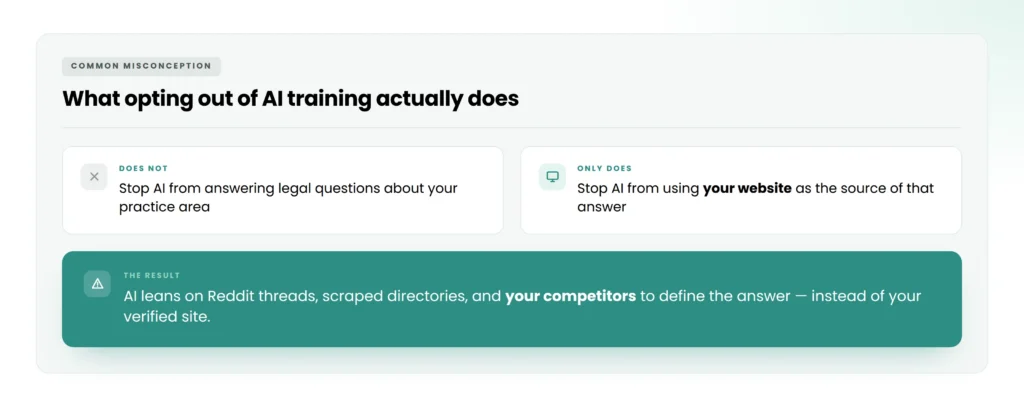
When a potential client opens Google’s intelligent search box and types a multi-paragraph scenario about a contested custody battle or a catastrophic trucking accident, Gemini will still generate a comprehensive AI response.
If your firm has opted out of generative search, the AI does not go silent. Instead, its forced to pull information from the sources that remain in the index:
- Aggressive competitors who stayed opted in.
- Outdated third-party data-scraping directories.
- Unverified legal forums and unmoderated Reddit threads.
By opting out, you deprive yourself of the ability to serve as the ground-truth source. You hand over control of the narrative. If the AI generates a flawed summary of local law, it will cite your competitor’s site as the authority, giving them the high-intent lead while your firm remains entirely absent from the conversation.
To maintain market authority, you cannot hide behind this toggle. You must actively protect and verify your law firm’s brand presence, ensuring that your verified, highly structured digital assets are precisely the materials the AI is forced to rely on.
Firm-by-Firm Analysis: The True Cost Across Segments
The operational risk of toggling Google’s generative search controls varies depending on the operational scale and revenue model of your practice. Here is how this decision affects different firm segments.
| Firm Size | Primary Risk of Opting Out | Strategic Recommendation |
|---|---|---|
| Solo Practitioners | Complete loss of top-of-funnel client acquisition; ceding ground to aggregator sites. | Never opt out. Rely on AI citations to achieve more than your ad budget allows. |
| Small Firms (2–10 Attorneys) | Competitors capture localized high-intent queries; reduced regional reach. | Never opt out. Dominate localized prompt clusters using scenario-based pages. |
| Mid-Sized Firms and Regional Boutiques | Partner committee paralysis; erosion of institutional thought leadership. | Do not opt out. Protect your practice areas with surgical schema, not a strict shutoff. |
1. Solo Practitioners: The Threat to the Case-Intake Funnel
Solo attorneys operate on lean budgets and minimal marketing overhead. They can’t afford to spend $25,000 a month on Google Local Services Ads or hyper-competitive PPC keywords in order to compete with regional volume mills.
For a solo practitioner, generative search is the ultimate leveler of the playing field. AI engines prioritize technical clarity, direct answers, and verified local entity data over raw domain size. When a local consumer asks a hyper-specific question, a solo attorney who maintains a clean, authoritative practice page can easily earn the primary citation instead of a huge firm with a hundred attorneys.
If a solo attorney opts out of generative search, they voluntarily eliminate their most cost-effective client acquisition channel. You become entirely dependent on traditional blue links. These links are getting pushed further down the mobile screen every month. For solo practitioners, opting out is an unforced error that restricts case intake.
2. Small Firms (2–10 Attorneys): The Squeeze in the Local Market
Small firms don’t grow on brand size. They grow on reputation earned in one metro, across three or four practice areas like family law, criminal defense, and residential real estate, where the client gets the partner on the phone instead of a paralegal.
In mid-sized markets the competition for visibility is brutal, and it now runs through chat. A prospective client types something like “Who are the top-rated collaborative divorce lawyers near me who handle contested business assets?” and Gemini answers by picking through the local firms it has on file.
If your small firm opts out, Google can’t pull your attorneys’ bios, case results, and practice FAQs into that recommendation loop. The search engine will skip your firm and highlight your direct local competitors. Small firms that opt out will find themselves squeezed between aggressive solo operators who embrace AI search and huge regional players who buy their way onto the screen.
3. Mid-Sized Firms and Regional Firms (10–50+ Attorneys): The Governance Trap
Mid-sized firms face the greatest internal pressure to hit the opt-out switch. Because these firms are managed by executive committees, risk management partners, and general counsel, conservative voices often dominate marketing discussions.
Partners in corporate disputes, mergers and acquisitions, or high-stakes defense often argue: “We don’t need AI traffic. Our reputation is built on referrals, and we can’t afford the malpractice risk of a bot distorting our insights.”
This perspective ignores how modern corporate counsel and commercial clients conduct research. In-house legal teams and executive decision-makers use generative search platforms at an unprecedented pace to conduct preliminary research, identify niche regulatory experts, and benchmark outside counsel.
If a regional firm opts out of generative search, its published thought leadership, such as white papers, statutory analyses, and appellate case breakdowns, becomes invisible to corporate decision-makers using AI Mode. The firm’s prestige remains intact in traditional search, but it slowly disappears from the main research workflows of the next generation of clients.
Decoding the New Generative AI Reports in GSC: The Impressions Blind Spot
Along with the opt-out switch, Google rolled out a dedicated Generative AI performance tab in Google Search Console. For legal marketing teams that want to measure their firm’s visibility in AI Overviews, this new dashboard provides critical data.
The Data Google Gives You
In the new report, site owners can filter performance data specifically for generative search surfaces. The report reveals:
- Generative Impressions: The total number of times a URL from your firm’s website was displayed as a cited source or reference in an AI Overview or an AI Mode response.
- Top-Performing Pages: Which specific practice area pages, attorney profiles, and blog posts are being extracted by Gemini to build answers.
- Geographic and Device Distribution: Where users are located when your content is cited, and whether those queries come from desktops or mobile devices.
The Key Blind Spot: Zero Clicks and No CTR
Noticeably absent from the new report are two foundational metrics: clicks and click-through rate (CTR).
Google’s decision to withhold click metrics from the initial rollout of Generative AI reporting has sparked intense debate among SEO professionals. Google argues that generative search interactions are fluid and conversational, which makes traditional click attribution technically complex. In reality, withholding click data shields Google from broader publisher scrutiny concerning zero-click searches.
For legal marketers reporting to managing partners, this creates an operational challenge. You can show the executive committee that your trucking accident guide earned 15,000 AI impressions this month, but GSC won’t tell you how many of those users clicked through to your site.
How Law Firms Must Measure Generative ROI
Because Search Console deliberately obscures direct click attribution, law firms must stop relying on standard website traffic as their sole metric of marketing success. You must assess generative visibility using secondary signals and signals located deeper in the funnel:
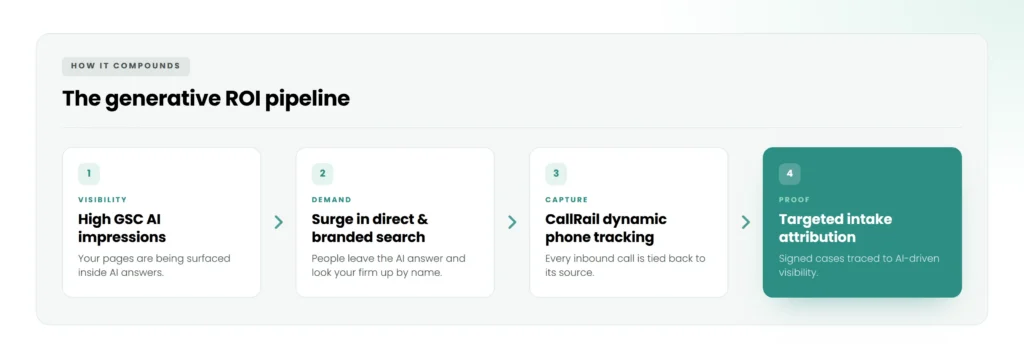
- Branded Search Lift: When Gemini cites your firm in an AI Overview, many users don’t click the tiny source link inside the summary. Instead, they read the recommendation, open a new tab, and search for your firm’s specific brand name. Track the correlation between rising generative impressions in GSC and spikes in organic branded search volume.
- Dynamic Call Tracking: Potential clients in crisis frequently dial phone numbers displayed directly within search experiences without visiting deeper pages of the site. You can track this by using dynamic call tracking numbers across your entire digital footprint to capture calls.
- Intake Form Attribution: Update your initial client intake questionnaires. Train your intake staff to ask new leads: “Did you find us through a Google AI summary or search assistant?” You may discover that your most valuable corporate or personal injury inquiries were referred directly by Gemini, even if your analytics shows a flat line in raw organic web sessions.
The Real Solution: Control the Ground-Truth Source Through Architecture
Toggling Google’s opt-out switch is a blunt, binary reaction to a challenge that requires surgical precision. The solution to brand risk, bar compliance, and content protection is not hiding your site from search engines. Its about building an unassailable digital infrastructure that will force AI models to represent your firm with total accuracy.
Firms that dominate generative search focus on three architectural pillars:
1. Establish a True Information Gain
AI models don’t cite generic, commodity content. If your site is filled with basic three-paragraph summaries defining what negligence means in your state, Gemini will ignore you. It has already memorized those definitions.
To earn citations, your practice area content must demonstrate an authentic information gain, proprietary insights, local court procedural realities, and firsthand strategic perspectives that exist nowhere else on the web. By focusing on making your firm the definitive source of truth, you deliver unique, high-trust data that AI search engines are algorithmically required to cite.
2. Deploy Deep, Machine-Readable Schema
You don’t need an opt-out switch to reduce the risk of AI misinterpreting your credentials or practice capabilities. You need to translate your firm’s data into a language the algorithm can reliably understand.
Implement advanced JSON-LD Schema markup across your site. This is built into Civille’s approach to law firm websites: structuring critical firm, attorney, location, practice area, and FAQ information so search engines and AI systems can interpret it cleanly. Use LegalService, Attorney, and FAQPage schemas to explicitly define:
- The exact jurisdictions in which your attorneys are licensed to practice.
- The specific types of disputes your firm accepts.
- The physical street addresses of your verified office locations.
- Direct, highly factual answers to complex legal questions.
When your site is structured with rigorous technical schema, you eliminate the algorithmic ambiguity that leads to AI hallucinations. You hand the machine a verified index of your firm’s identity.
3. Build on a Foundation of Technical Speed
AI research engines operate within strict latency limits. When an engine like Gemini performs a real-time query fan-out to assemble an AI Overview, it scans dozens of potential sources in milliseconds. If your site is slow, bloated with unoptimized code, or structurally unstable, the crawler will discard your page and move on to the next available source.
That’s one reason Civille builds law firm websites with speed and technical performance as foundational requirements rather than after-the-fact optimizations. A fast, stable platform gives both users and search engines the baseline performance they need to access and process your content efficiently. Speed is not merely a user experience preference. Its a fundamental prerequisite for AI visibility.
Related: How to Improve Your Law Firm’s Page Speed
The Strategic Verdict: Leave the Switch On
Google’s Search Generative AI control provides an interesting glimpse into the ongoing struggle between content creators and artificial intelligence. But for law firms operating in competitive commercial or consumer markets, hitting the opt-out switch is an act of digital self-sabotage.
Opting out doesn’t insulate your firm from the AI era. It merely ensures that when potential clients ask Google’s conversational engine whom they should hire, your competitors will supply the answer.
The winning play in 2026 isn’t retreat. It’s staying visible, and on your own terms. Keep your digital footprint open, mark up your pages so machines don’t have to guess what your firm does, and publish the kind of legal analysis nobody else in your market can replicate. Do that and you become the source both searchers and AI engines have to come back to.
The search interface has changed, but the fundamentals haven’t: authoritative content, precise technical structure, and a fast, high-performance website still create the foundation for visibility. Those are exactly the principles Civille builds around. It’s time to talk to Civille.