
For decades, legal marketing research has started with keyword analysis. You hunted for highly searched phrases like “car accident lawyer near me” or “divorce attorney,” and you built web pages around those phrases. That is rapidly changing. Keyword research is no longer the beginning and end of marketing research. As search enters the era of AI Overviews, SearchGPT, Gemini, and Claude, this traditional model shows only half the picture.
The first step is to map your prompt clusters against the content already living on your website. Start by identifying your gaps: which complex prompts currently have no clear answer anywhere on your site? Then look for alignment opportunities: which practice area pages can be expanded so they naturally address the follow-up prompts users ask along the way?
A legal topic that shows zero search volume in traditional tools may tell a different story in AI prompts. Law firms still prioritizing content based on traditional keyword metrics are ignoring the AI elephant in the room.
Keyword Research vs. Prompt Research: A Critical Shift
Understanding the difference between these research methodologies is crucial for building an effective content strategy in 2026.
- Keyword Research: Analyzes static search queries, estimated monthly traffic, and keyword competition on traditional search engine results pages.
- Answers: What word strings do users type into search engines?
- Prompt Research: Analyzes multi-step questions posed to AI systems and how prompts shape generated responses.
- Answers: What complex scenarios do potential clients describe, and what follow-up questions will they ask?
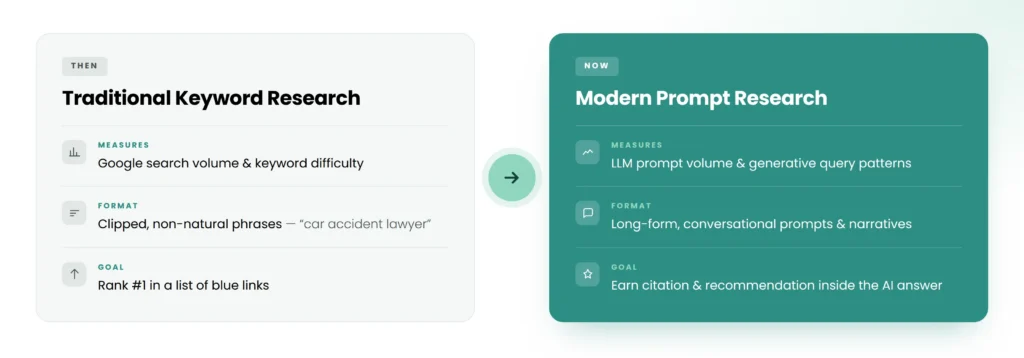
In legal marketing, the distinction is stark. A potential client rarely types a 40-word narrative into traditional Google search. Yet in AI assistants, they regularly paste entire police report excerpts, describe family asset disputes, or timelines of workplace discrimination, asking the AI to evaluate options and recommend local specialists.
How AI Engines Work: RAG and Vector Search
To understand why prompt research works, one must know how large language models (LLMs) generate responses to narrative prompts.
When users ask complex questions, the AI model doesn’t just scan the internet for keywords. Instead, it uses a process called Retrieval-Augmented Generation (RAG):
- Semantic Decomposition: AI breaks down the user’s prompt into semantic concepts
- Vector Conversion: Converts the prompt into a mathematical vector and searches databases for content in the same vector space
- Passage Retrieval: Pulls passages from authoritative pages addressing these concepts
- Answer Generation: Creates a natural-language summary citing sources
If your content only matches exact keyword phrases, it won’t connect with the semantic vectors generated by long, multi-part prompts. To be cited by AI, your content must provide deep, contextual explanations aligned with user intent. You can dive deeper into how algorithms evaluate this quality in our guide on creating truly helpful content for legal search engines.
The Hidden Demand Trap in Legal Searches
The biggest pitfall in modern legal marketing is ignoring topics with “low” volume in tools like Google Keyword Planner.
A traditional tool might report just 20 monthly searches for specific phrases like “how’s a family business divided in divorce.” Relying solely on keyword volume would lead a firm to reject this topic in favor of generic terms like “divorce lawyer.”
Yet in generative engines, this same topic may have massive prompt volume. Potential clients regularly submit long prompts asking AIs to explain business valuation methods, tax implications, and buyout structures during divorce.
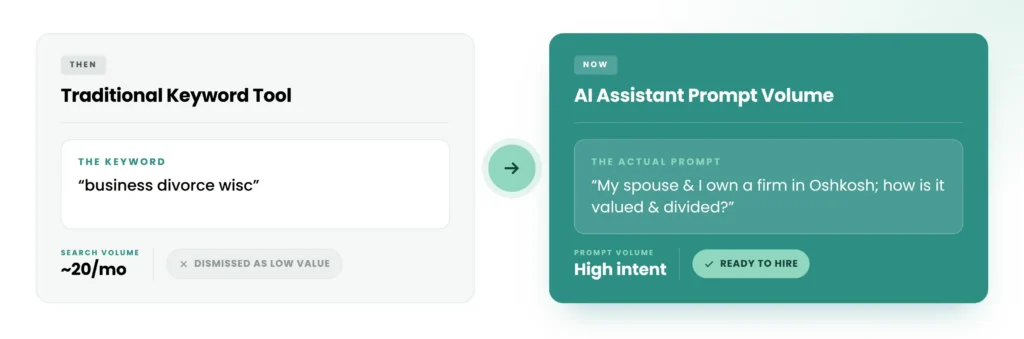
When a law firm doesn’t research prompts, it completely misses these high-intent opportunities. Clients asking detailed prompts aren’t casual searchers. They’re high-value, qualified leads actively seeking an expert.
Legal Topic Prioritization: The Dual-Research Matrix
Instead of treating SEO and GEO as competing tactics, top-performing firms combine keyword and prompt research into a unified content prioritization strategy:
| Low Keyword Demand | High Keyword Demand | |
| High AI Prompt Demand | GEO Opportunity TargetsBuild for the Answer: Create targeted, scenario-based guides. Focus on direct explanations, concise summaries, and structured data that AI assistants can pull directly into conversation. | Flagship AssetsInvest Heavily: Build comprehensive practice hubs. Structure for traditional blue links while embedding clear schema, FAQs, trust signals, and entity data for AI citation. |
| Low AI Prompt Demand | DeprioritizeSkip or Consolidate: Avoid spending marketing budget on topics that demonstrate neither search volume nor conversational inquiry. | Classic Search TargetsBuild for the Click: Standard transactional pages optimized for quick local conversion, clear calls to action, and immediate contact. |
A 4-Step Framework for Legal Prompt Research
1. Prompt Discovery
Identify the actual questions potential clients are asking across generative platforms (Gemini, ChatGPT, Calude) and AI-assisted search experiences. There are a few ways to go about this. You can rely on your experience in the field of course, but you can also analyze consultation transcripts and find what scenarios and concerns clients verbalize and research “prompt branch” patterns in AI tools’ follow-up suggestions.
2. Prompt Clustering
Group individual prompts into intent-based clusters. A single legal topic like commercial vehicle accidents will yield dozens of related prompts regarding driver logbook violations, corporate liability, and immediate medical bill coverage. These clusters reveal the full narrative journey a client takes when researching a crisis.
3. Prompt Mapping
To effectively optimize your website for complex user queries, start by mapping your identified prompt clusters against your existing website content. This process will help you identify content gaps. Specifically, it’ll help to identify which complex prompts currently lack clear, comprehensive answers on your site.
Simultaneously, analyze how to align existing content by determining which practice area pages can be strategically expanded to address follow-up prompts naturally, thereby enhancing topic depth and user journey continuity. This dual approach ensures your content meets user needs and gets surfaced in AI chats.
4. Response Optimization (GEO Formatting)
To optimize your content for both readers and generative AI models, start by organizing each section of the page with appropriate headings that follow the standard heading hierarchy.
Next, add FAQ sections that use exactly the language you discovered during your prompt research. If people ask in AI chats “How long does a personal injury lawsuit take?”, use it verbatim as the question heading. When your FAQs reflect how people actually speak, you keep readers engaged and make it easier for language models to understand and draw from your content.
Finally, be specific about who you are and where you practice. List local courts (e.g., California Superior Court), cite the regulations that actually apply (e.g., U.S.C. Title 42), indicate bar credentials, and include verifiable firm data. Specificity gives you two things: it builds reader trust and provides generative engines with concrete facts they can cite accurately. Equally important — make sure basic information such as the firm’s address and attorney license numbers is identical everywhere it appears online. Inconsistencies disorient AI systems and weaken how your brand appears in their results.
How to Measure GEO Success
One of the biggest challenges with prompt research is that traditional rank trackers can’t measure conversational queries. There’s no static keyword ranking for a 50-word custom prompt.
To evaluate your GEO performance, your firm must monitor three new indicators of visibility:
1. AI Overview Referral Traffic in Google Search Console
Google Search Console tracks impressions and clicks from pages that appear inside AI Overviews. By filtering your performance data by landing pages that feature deep prompt optimizations, you can track how often AI summaries drive high-intent users to your site.
2. Citation Share of Voice
Run regular sampling audits across major AI platforms (Gemini, ChatGPT, Claude) using your target prompt clusters. Track how frequently your firm is cited as a primary source compared to local competitors.
3. Conversion Quality from Organic Channels
Because users arriving from AI Mode have already read a synthesized summary of your capabilities, they convert at a significantly higher rate. Track your intake form submissions and phone calls to measure whether leads originating from organic content are better qualified and ready to hire. You can learn more about aligning your site for these high-intent leads by making your firm the definitive source of truth in your practice areas.
Technical Infrastructure: The Foundation of GEO
You can do all the prompt research you want, but none of it pays off if your website isn’t built to handle how modern search engines work. AI models favor sites with clean structure, schema markup, and pages that load quickly, and they tend to skip over the ones that don’t.
If an AI engine has to choose between two law firms that offer similar legal insights, it’ll consistently cite the firm with the cleaner code and faster load times. Technical performance serves as a primary indicator of operational reliability. Ensuring your platform is built to optimize for speed and user experience provides the necessary foundation for all of your content and prompt optimization efforts.
How Civille Builds Authority Engines for SEO and GEO
At Civille, we don’t choose between traditional SEO and modern GEO. We build high-performance authority platforms designed to capture demand across both.
We ensure your website ranks for the classic keyword terms that drive immediate local traffic, while structuring your legal expertise so that AI models naturally cite your firm during complex, conversational AI research sessions.
Are you ready to expand your firm’s visibility beyond keywords? Do you want to capture the next generation of AI-driven legal leads? Then it’s time to talk to Civille.