For as long as digital legal marketing has been around, branded search was the one piece of digital real estate a law firm could take for granted.
You fought in the trenches for non-branded, category keywords like car accident lawyer or business litigation attorney. You paid for Local Services Ads and PPC clicks. You spent months building authority so your practice area pages would climb into the top three organic positions.
By the time someone actually knows your firm’s name from a billboard they’d passed every morning on the way to work, a neighbor who said “those people took care of me,” a mention on the evening news, or a name they’d Googled once and half-remembered, you’d think the hard part was behind you. They’d sit down, type those two or three words into Google, and there you’d be with your name, plain as day, right at the top. There was a phone number they could actually see and pages that looked like they’d answer the questions keeping them up at night. They’d click. They’d land on your site. And when they finally got up the nerve to call, a real person would pick up.
That guaranteed handoff just vanished.
Over the course of a single month, Google quietly rewrote the rules of branded search. According to industry data published by Search Engine Land and tracked by DemandSphere, the presence of Google AI Overviews on branded queries surged from 26.12% on September 1 to over 80% by the end of the month, peaking as high as 90.48% on September 27. Separate enterprise testing conducted by Nectiv co-founder Chris Long confirmed the explosion, revealing AI Overviews triggering on 93 out of 100 tracked brand searches.
Google didn’t announce this rollout, and it’s no longer treating branded queries as simple navigational lookups. Instead of stepping aside when a prospect searches directly for your law firm, Google is now stepping between you and your hardest-earned leads, inserting a machine-generated interpretation of your practice before the user ever reaches your website.
The September Surge: Breaking Down the Numbers
To understand how urgent this shift is, legal marketers have to look at the speed of the rollout. For over a year, Google was relatively cautious about deploying AI Overviews on pure navigational and branded searches. When a user typed in a specific company or law firm name, the search engine recognized that the user wanted to reach a specific destination, not read an encyclopedia entry.
Through the first half of September, AI Overviews hovered between 26% and 35% on branded queries. Then, in the final week of the month, Google flipped the switch:
| Tracking Metric / Source | Early September Baseline | Late September Surge | Peak Recorded Presence |
| DemandSphere (All Markets & Devices) | 26.12% (Sept. 1) | 82.06% (Sept. 29) | 90.48% (Sept. 27) |
| Ahrefs (U.S. Desktop Branded Dataset) | 65.10% (August Baseline) | 82.91% (Sept. 29) | 82.91% (Sept. 29) |
| Nectiv / SerpApi Enterprise Brand Audit | Unannounced Rollout | 93.00% of Tested Brands | 93 of 100 Brands |
The numbers shifted a little depending on who was counting. Mobile, desktop, searches where people typed a firm’s name plus a city or the word “review,” they all landed in slightly different places. But the studies kept pointing the same direction: more than four out of five times, when someone searches a brand’s name now, Google answers with an AI-generated summary before anything else.
And here’s the part that matters. Those studies counted the summary as “triggered” if it simply showed up, whether or not your firm was actually the one doing the talking. So someone can type your name into Google, and right above your own website, the AI will summarize everything it’s read about you. Your cases. Your reputation. Your practice. Only the sources feeding that summary might be a legal directory, a news story from two years ago, or a competitor who did a better job of answering the question. Whether that helps you or hurts you comes down to one thing: what’s out there about you, and whether your own site is saying it better than anyone else.
Why Branded Interception Is a Crisis for Law Firms
If you sell shirts or software, an AI summary sitting above your name is mostly an annoyance. It’s just a few fewer clicks on a chart somewhere. Legal isn’t like that. One signed client, a commercial case, a medical malpractice claim, a catastrophic injury, can be worth a lot. When Google slides in between you and someone who searched your name, that isn’t a traffic dip. That’s a client you may never meet.
Think about who’s typing those searches. Somebody enters your firm’s name plus “reviews.” A partner’s name plus “trial record.” Your name plus “divorce consultation.” That person isn’t browsing. They have a serious problem, they’ve been thinking about it for weeks, and you’re on the short list. They are about to make up their mind about you.
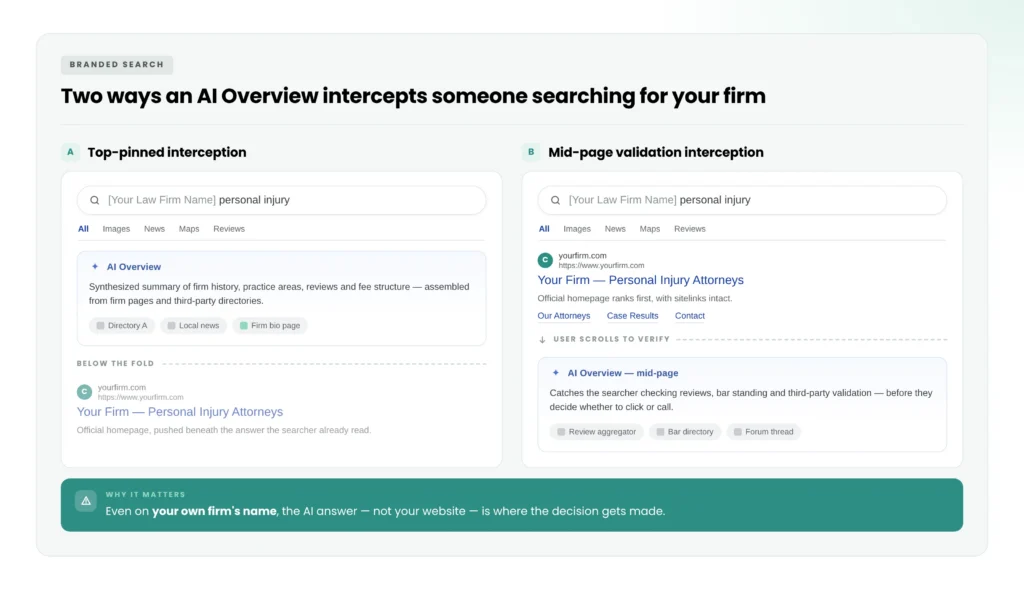
Not long ago, your website got to make that first impression. You chose what they saw. Now Google writes the first few lines of your story. And when it does, three things can go wrong before that person ever hears your voice:
1. The Third-Party Source Hijack
Google’s Gemini engine doesn’t build a branded AI Overview simply by reading your homepage hero text. It synthesizes a profile of your firm by pulling from its broader Knowledge Graph and running a rapid query fan-out across third-party domains.
If what’s on your website is thin, old, or hard for Google to make sense of, the AI doesn’t stop. It just looks elsewhere. And “elsewhere” is a bad place to have your reputation decided. A law directory nobody’s updated since you moved offices. A review site where someone vented. A state bar page that lists a sanction without the context. A two-paragraph crime-blotter item from a local news site. A Reddit thread where a stranger misquoted what happened at trial.
You can pour thousands into a beautiful new homepage and it won’t matter. Because the person searching your name never sees the homepage the way you intended. They see a tidy little AI summary built from a profile that went stale five years ago, or a forum complaint dragged up out of nowhere.
That’s the real shift. Google now assembles your reputation from whatever’s lying around on the open web. Which means you have to do something firms used to not worry about too often. You have to go out and actively claim and verify every place your name appears before an algorithm does it for you.
2. Practice Area Mischaracterization and Hallucinated Scope
Firms change. Every practice does. The firm that ten years ago handled the traffic tickets, the simple wills, the neighbor’s fence dispute may now do nothing but serious plaintiff’s work. But the internet isn’t always great at keeping up with that kind of growth.
The old listings don’t die. The directory profile from a decade ago, the news mention, the bar page, they’re still out there, and Google never forgets where it found them. So when someone searches your name with a question attached the AI can reach back and answer with what you used to be. It may tell them, with complete confidence, that your firm focuses on traffic offenses. Or family law.
Sometimes it’s worse than outdated. Sometimes it just makes things up. It might invent a fee schedule. It might promise free consultations when you charge for an initial strategy session. It might barely distinguish between you and another firm with a similar name two states away, and answer the question about you using details from them.
You’ve spent a decade becoming who you are now. Google is still reading a version of you that no longer exists.
3. Competitor Leakage Inside Branded Modifiers
Not every branded search is a pure one-word or two-word lookup. High-intent legal consumers frequently search using branded validation modifiers:
- [Firm Name] vs [Competitor Firm]
- [Firm Name] settlement amounts
- [Partner Name] hourly rate
- Is [Firm Name] good for contested custody?
Ask Google a more specific question, “How does this firm handle custody disputes, what are their injury settlements like,” and the AI often doesn’t treat it as a question about you at all. It treats it like you asked it to go shopping for options. And so, in the middle of explaining how your firm handles a case, it pauses and says, essentially, “here are a couple of other local firms worth looking at.”
The competitors it names sit right there in the summary. Sometimes in a carousel, a neat row of clickable cards. The firm across the street. The one that’s been trying to outrank you for years. Presented politely, helpfully, as “alternative local options.”
Think about what just happened. Someone knew your name. They typed it in because they wanted you. And Google, trying to be helpful, handed them to your competitor before they ever reached your site.
Where Branded AI Overviews Appear (And How They Shift Behavior)
One thing worth noting from the late-September rollout is that branded AI Overviews don’t always behave like the massive, screen-filling blocks you see on generic informational searches.
Most of the time, the AI summary appears right at the top of the screen, above your homepage link. But analysts have also caught Google doing something sneakier. Sometimes the summary shows up halfway down the page, tucked just under your homepage link or nestled below the row of sitelinks.
It would be easy to call that harmless. Your homepage still sits at number one, so who cares? But that thinking misses how people actually size up a law firm.
When someone searches your name, they rarely click the first link without looking around first. They scroll. They’re hunting for signs they can trust: the Google reviews, a news story, whether the bar has anything on you, how your peers rate you. That is the exact zone where the mid-page summary now lives. And because it sits where people go to decide whether you’re safe to call, it becomes the paragraph that makes up their mind.
If that paragraph is sharp and sure, built from things you’ve actually done, it moves them faster toward the phone. If it’s vague or stale, or propped up by some tired directory listing, they close the tab without ever clicking your name.
Why Clicks Are Now a Lagging Indicator for Brand Health
The surge in branded AI Overviews exposes a dangerous blind spot in how most law firms review their monthly marketing reports: branded organic clicks are now a lagging indicator.
If your team is only watching two numbers on your branded search (are we still number one for our name, and how many people clicked the homepage last month), you’re flying blind. Those two numbers could look perfectly healthy while the problem is already happening.
It gets worse. Google recently added AI performance reports to Search Console, which sounds like it would finally show you what’s going on. But here’s what the site owners found when they opened them: Google will tell you how many times the AI summary appeared in front of your audience. That’s it. It deliberately won’t tell you whether anyone clicked anything. No click numbers. No click-through rate. Just impressions, as if seeing the summary and acting on it were the same thing.
So you can’t catch the damage early, because Google hides the signal that would reveal it. And by the time you finally notice the truth in Google Analytics, when branded homepage clicks have fallen fifteen or twenty percent, the harm is already old. The summary has been live for weeks, maybe months. The story it tells about you has already set. The third-party citations it chose have already hardened into place. And the clients who would have called you went somewhere else long before you ever saw the number drop.
The 4-Step Branded AI Defense Playbook for Law Firms
You can’t stop Google from generating AI Overviews on your firm’s name, and as we’ve covered before, using Search Console’s opt-out toggle only forces the AI to rely exclusively on third-party sites to describe you.
Instead of retreating, law firms have to treat branded AI Overviews as a live, high-stakes intake surface and force Google’s Gemini models to use your website as the undisputed ground truth.
1. Run a 30-Day Branded Query & Modifier Audit
The easy version goes like this. Sit at your desk, logged into your own Google account, type the firm’s name, watch your site come up first, and call it a day. But that search tells you almost nothing, because Google knows exactly who you are. It has spent years learning what you want to see. It hands you your own website because it knows you’d be annoyed by anything else.
The person who matters is searching from a phone in a parking lot an hour after talking to your competitor. Or from a laptop at a kitchen table at midnight. You have to see what they see. Log out of your Google account, open an incognito window on both mobile and desktop, and work through the full list of things a stranger might type:
- Pure Brand Name: [Firm Name] and [Firm Acronym + Law]
- Attorney Names: [Managing Partner Name] and [Partner Name + Attorney]
- Trust & Validation Modifiers: [Firm Name] reviews, [Firm Name] results, [Firm Name] complaints, [Firm Name] cost
- Practice + Brand Combinations: [Firm Name] personal injury, [Firm Name] divorce lawyer
Treat it like building a case file. For every query that triggers an AI Overview, write down three things: the exact wording of the summary, whether it sits at the top or mid-page, and the exact URLs in the source cards. You cannot fix a story you have not read.
2. Reclaim the Source Stack on Your “About” and Attorney Bio Pages
When an AI Overview tries to summarize a firm, it goes looking for facts it can actually state. Founded in what year. Serving which courts. Handling which cases. Winning what verdicts. Most law firm About pages give it nothing to work with.
This is the irony. Your About page is often the one place where your firm gets to speak for itself, and half of them read like movie posters. “We fight like sharks.” “We stand in the gap.” “We’ll stop at nothing.” Fine slogans, all of them, but the AI doesn’t need a slogan. It needs a sentence. If your About page never gets around to the hard facts, the AI won’t wait. It will skip your site and pull those facts from some directory that bothered to write them down in plain text.
So rewrite those pages the way you’d answer a good question under oath: plainly and completely. Add concise, factual summary blocks and FAQ modules to your About and Bio pages that state who you are, what cases you accept, and where you practice. Make your website the easiest place to learn the truth about your firm.
3. Lock Down Entity Disambiguation with SameAs and LegalService Schema
Google has a problem, and it starts with how many law firms share a name. It also knows that one firm can have six different profiles scattered across six different sites. Unless you tell it otherwise, it may not be sure that the firm on your website is the same firm as the one on the bar page, or the LinkedIn page with the new logo, or the directory listing with the old phone number.
So you make the introductions yourself. You clear away every bit of technical friction between your website and Google’s Knowledge Graph.
At Civille, we build AI-ready entity structure and legal schema directly into the code of your website. For branded search defense, three pieces of it are non-negotiable:
- LegalService & Organization Schema: This declares your official legal entity name, founding date, physical office location, phone numbers, and primary practice areas.
- Attorney & Person Schema: This connects every partner and associate straight to the parent firm, verifying bar admissions, alumni credentials, and published legal articles.
- SameAs Property Linking: This links your website’s code directly to your State Bar profile, Google Business Profile, LinkedIn page, and verified directories. It tells Google’s crawler, in effect: “All of these profiles belong to this exact firm, and this website is the primary authority.”
4. Purge Stale Third-Party Discrepancies
The internet doesn’t age, and it doesn’t throw anything away. The Avvo profile you wrote when the firm still handled traffic tickets. The chamber of commerce page with the office you moved out of three years ago. The practice page for a service line you shut down and forgot to delete. None of it expires. It all sits there, live, every piece of it telling a slightly different and slightly wrong version of who you are.
The AI walks into that mess without a clue which facts are current and which are fossils. It can’t tell the two apart. So it cites them.
If your audit turns up exactly this, an outdated Avvo profile, an old address, a practice area you no longer offer, don’t fight the summary. Go fix what the summary is reading from. On your own site, consolidate or 301-redirect those obsolete pages so they stop leading back to work you no longer want. Then open the bios on the major directories and rewrite them until they line up with your live website. Same positioning. Same practice focus. Same consultation policies.
When every page tells the same story, the AI stops guessing. It just repeats what it reads. And when every source reads the same way, the AI Overview has no choice but to tell the story you wrote.
Speed and Structure: Ensuring the Click Still Converts
When this works, the summary becomes a warm introduction. The person reads it, trusts it, and clicks the citation that leads to you. They’re ready to call.
But they’ve already read about you. Their patience for anything slow or broken is gone. If they click and land on a page that takes four seconds to load on a phone, the whole thing collapses before you ever hear from them. They close the tab and tap the next name down.
Build for speed and structure and you get two things. Google’s real-time crawlers can pull your verified facts without timing out, and the person who just read the summary moves straight from that moment into a live intake conversation.
Take Back Control of Your Firm’s Name
Here is the number that tells the story: AI Overviews now appear on over 80% of branded queries, up from 26%. That is not a corner of Google getting a little generative. That is Google deciding that nearly every time someone looks up a firm by name, it will speak first.
Which means ranking first for your own name is no longer the finish line. It’s the starting point.
If Google is going to write the first summary your referrals and prospective clients read, then your digital infrastructure has to dictate every word of that script. Authoritative, fact-dense brand pages. Rigorous entity schema. Fast, clean technical architecture. Put those together, and when Google answers for your firm, it answers in your voice.
If you want to see how Google’s AI Overviews are framing your firm right now, and build the infrastructure that locks down your branded real estate, it’s time to talk to Civille.