In late 2020, with COVID slowing his caseload, California trial lawyer Mike Mandell started posting short legal explainers on TikTok to drum up business for his new firm. By April 2021 he had five million followers. Today his YouTube channel, Law By Mike, is closing in on 20 million subscribers.
He’s the biggest name in a small but very real club. A handful of attorneys have built audiences in the millions by doing something most law firm marketing never pulls off: getting people to watch legal content on purpose, for fun, on their lunch break.
Below are the lawyer influencers with the biggest followings on TikTok and YouTube in 2026, what’s working for them, and what your firm can borrow (plus a few things it shouldn’t). Follower counts move fast, so treat every number here as a fall 2026 snapshot.
Why Lawyers Keep Winning on TikTok and YouTube
The audience is huge, and it isn’t going anywhere. Pew Research Center’s latest survey found that 84% of U.S. adults use YouTube and 37% use TikTok, with about a quarter of adults on TikTok every day. TikTok’s U.S. future also stopped being a question in January 2026, when the deal moving its American operations into a new joint venture led by Oracle, Silver Lake, and MGX officially closed. If your firm was waiting for the ban drama to settle, it has.
Legal content has a built-in advantage, too. The law shows up in viral clips constantly: a traffic stop that goes sideways, a landlord who won’t return a deposit, a boss who says you can’t talk about your pay. Viewers have questions about those moments, and a lawyer is the one person who can answer with real authority. Plenty of people also have legal questions they’d rather not ask out loud. A 60-second video gets them an answer without a consultation or an awkward phone call.
The Lawyer Influencers With the Biggest Audiences in 2026
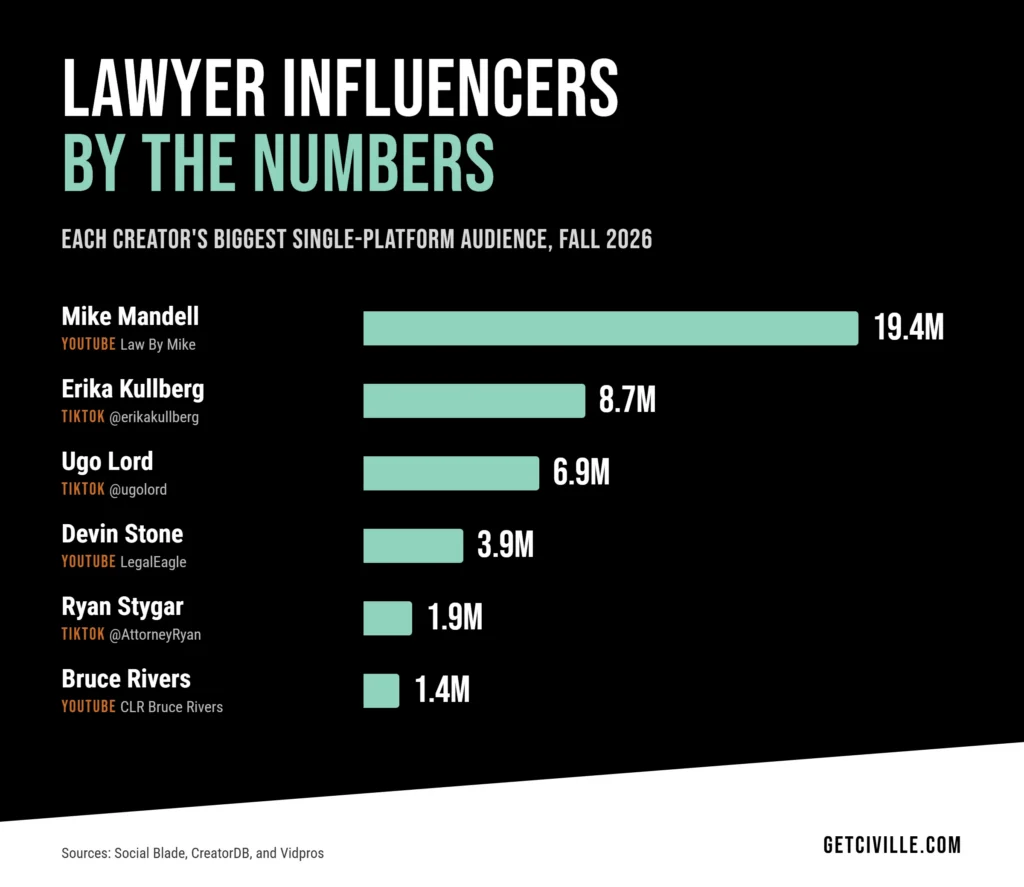
These six attorneys have turned legal know-how into serious followings. If you want more YouTube-specific picks, our list of the top lawyer YouTube channels has a few more.
Mike Mandell (Law By Mike)
Audience: nearly 20 million YouTube subscribers and about 11.4 million TikTok followers
Mandell is a Duke Law grad, licensed in California since 2012, who founded Mandell Law. His videos tackle the stuff people actually wonder about, like whether something is technically a crime or what to say (and not say) when police stop you. The hooks are pure entertainment, but every answer is grounded in real law. He’s still growing fast, too. Trackers had his channel around 14.1 million subscribers in August 2025, so he’s added more than five million in a little over a year.
Devin Stone (LegalEagle)
Audience: about 3.9 million YouTube subscribers
LegalEagle is proof that long-form video still works. Stone, an attorney, breaks down headline trials and legal news in detailed videos and mixes in reactions to legal movies and TV shows. His TikTok following is under 300,000, which tells you exactly where his audience lives.
Erika Kullberg
Audience: nearly 9 million TikTok followers and more than 21 million across platforms, by her own count
Kullberg went to Georgetown Law and worked in corporate law before going full time on content. Her signature move is reading the fine print so you don’t have to, from loyalty programs and travel fees to consumer contracts. It’s legal training pointed at everyday money problems, and it’s one of the smartest niches on the app.
Ugo Lord
Audience: about 6.9 million TikTok followers and 2.2 million YouTube subscribers
Lord, a California attorney licensed since 2013 who calls himself “The Modern Attorney,” built his following on reaction videos. He takes viral clips of police encounters and public confrontations and explains what the law actually says about them. The format rides whatever’s already trending, which is a big reason it travels so well.
Bruce Rivers (CLR Bruce Rivers)
Audience: nearly 1.5 million YouTube subscribers
Rivers is a Minneapolis criminal defense lawyer and a board-certified criminal trial specialist. His channel, Criminal Lawyer Reacts, started when his son suggested breaking down rap music videos from a defense attorney’s point of view. Now he’s just as likely to cover bodycam footage, usually pausing on the exact moment someone talks themselves into trouble. If you run a criminal defense firm, his channel is worth an afternoon of your time.
Ryan Stygar (@AttorneyRyan)
Audience: about 1.9 million TikTok followers and nearly 1.3 million on Instagram
Stygar spent several years as a firefighter before law school. When he started Centurion Trial Attorneys, his San Diego employment firm, he began posting workers’ rights videos as a way to bring in clients. He covers wrongful termination, discrimination, and what your boss can and can’t legally do. Nearly everyone watching has a job or wants one, so his audience and his client base are basically the same people.
What Your Firm Can Learn From the Big Accounts
You don’t need 10 million followers for video to pay off. A family law attorney with 15,000 local followers might sign more cases than a national account 10 times that size. Here’s what the top creators get right.
Answer the questions people are already asking. Mandell answers “is this illegal?” Stygar answers “can my boss do that?” Start with the 20 questions your intake team hears most and you’ve got months of content. Our guide on how to start a TikTok as a lawyer walks through the setup.
React to what’s trending. Lord and Rivers grew by adding legal context to clips people were already watching. If a viral video touches your practice area, a quick stitch while it’s hot can go a long way.
Use short-form for reach and long-form for trust. This one comes with a warning. In May 2026, employment attorney Vince White said his firm would stop making TikToks and YouTube Shorts after a four-month experiment. Calls from the short clips were often frivolous or flat-out abusive, and they wore down his intake staff. His longer YouTube videos brought in better-prepared clients. Your results may differ, but plan for volume before you go viral. Intake tools that screen and route leads make a real difference.
Make your videos findable. YouTube is a search engine, and solid titles, captions, and descriptions help your videos show up in Google, too. Our YouTube SEO for lawyers guide covers the details.
Be a person. Nobody follows a logo. The accounts that grow put a real lawyer with a real personality on camera, which is the whole idea behind building your law firm’s brand on TikTok.
The Ethics Rules Still Apply on the For You Page
Going viral doesn’t suspend the Rules of Professional Conduct. Before anyone at your firm hits post, keep these in mind.
Client stories need consent. ABA Formal Opinion 480 makes clear that a lawyer’s confidentiality duty covers public commentary, informational videos included. That protection reaches information in the public record and even a client’s identity. A “you won’t believe what my client did” video can cross the line if viewers could figure out who it’s about, even with names changed.
Watch the comments and DMs. Answering one person’s specific legal problem in public can drift into giving advice, or even starting an attorney-client relationship. Keep it general, add a clear “not legal advice” note, and move real inquiries into your intake process.
Be careful paying creators. ABA Model Rule 7.2(b) generally bars lawyers from giving anything of value to someone for recommending their services, and a communication counts as a recommendation when it vouches for a lawyer’s abilities or professional qualities. North Carolina’s State Bar has even said lawyers can’t offer prize drawings for likes or follows that a platform displays to other users. Buying ad space is one thing. Paying a creator to tell their followers you’re great is another, so check your state’s rules first.
Florida firms, take note. Florida Rule 4-7.15(c) bans the voice or image of a celebrity in lawyer ads, social media included. The rule’s definition of celebrity covers anyone recognizable to an ad’s target audience, even at a regional or local level, so a locally famous TikToker could count. Morgan & Morgan sued the Florida Bar over the rule on Aug. 14, 2026. The Bar argued in October that the firm lacks standing, and Morgan & Morgan has asked for a preliminary injunction. As of this writing, there’s no ruling.
How Can Civille Help Your Firm Show Up on Video?
You don’t have to become the next Law By Mike to get real value out of video. You need a plan, a steady posting rhythm, and a website and intake process ready for the people who find you.
That’s where we come in. Civille works only with law firms, and our law firm digital marketing team can help turn your clients’ most common questions into content, make sure every video points back to a site that converts, and get intake ready for a spike in calls. Curious what that could look like for your firm? Reach out to the Civille team.