For a long time, the attorney bio was a neglected corner of the law firm website. It was often a dry list of credentials or a generic summary that sounded exactly like every other lawyer in the city. You probably viewed it as a necessary formality rather than a strategic marketing asset.
In 2026, that perspective is a liability.
As search moves toward an AI-driven landscape, your individual attorney bio has become the most important piece of real estate on your website. AI models like Google Gemini and SearchGPT are obsessed with expertise and experience. They are not looking for a firm logo. They are looking for a verified human expert they can trust.
If your bio is a copy-paste version of your resume, you are missing out on a powerful trust signal in modern SEO. You need to write for two audiences at once. You need to provide the emotional reassurance that a human client needs while giving the AI the structured data it needs to verify your authority.
This is your comprehensive guide to writing attorney bios that do more than just exist. This is how you build a bio that ranks in search and gets cited as a primary source by AI.
The Lawyer Bio as an Entity Hub
To write a successful bio today, you must understand how AI perceives you. Google and other search engines no longer see you as just a collection of keywords. They see you as an entity.
An entity is a distinct, well-defined thing in Google’s Knowledge Graph. You are a person. You have a law degree. You belong to a specific state bar. You practice in a specific city. The AI’s job is to connect all these dots to prove you are who you say you are.
Stop treating your bio like an afterthought. For AI models, this single page is the definitive source of truth about your practice. If the information there is scattered or vague, the bot isn’t going to piece the puzzle together for you—it will just drop you from the overview. A sharp, highly detailed bio essentially hands the algorithm a verified cheat sheet, making it incredibly easy to cite you as the go-to expert.
What Do Google Algorithm Updates Mean For Your Firm?
Writing for Human Trust First
Before we get to the technical code, your content must resonate with a human being. A potential client is usually reading your bio during one of the more stressful moments in their life. They are looking for a reason to trust you with their future.
The Narrative Opening
Do not start with where you went to law school. Start with why you do what you do. Your first paragraph should establish your unique value proposition. It should speak directly to the client’s problem.
- Instead of: John Smith is an associate at Smith Law who focuses on personal injury.
- Try: John Smith has spent fifteen years helping families in Lincoln, Nebraska navigate the aftermath of catastrophic accidents. He understands that a legal case is about more than just a settlement. It is about reclaiming your peace of mind.
This approach builds immediate rapport. It tells the reader that you understand their pain and that you have a proven track record of solving similar problems.
Information Gain and Strategic Detail
Google is now actively penalizing what experts call AI slop. This is generic, surface-level content that could have been written by a chatbot. To rank, your bio must provide information gain.
This means including details that only you can provide. Mention specific types of cases you have handled. Discuss local courts where you frequently practice. Share your philosophy on client communication. These specific details prove you have real-world experience that a machine cannot replicate.
Read More: Make Your Firm the Source of Truth for Legal Content
The Success Record
Do not be afraid to showcase your wins. Human clients want to see that you know how to win. AI models look for these results as proof of your expertise. Include a section for notable verdicts and settlements. Use specific numbers when ethically permitted. This data acts as a quantitative signal of your authority.
Writing for the AI Models
Once you have established the human narrative, you must format that information so an AI research assistant can read it perfectly. This is where most law firm bios fail. They hide the most important data in long, dense paragraphs that are more difficult for AI to successfully parse.
Structured Credential Blocks

AI models love lists. They are designed to find and categorize specific facts. You should use clear, bulleted sections for your credentials.
- Bar Admissions: List every state and federal court where you are licensed.
- Education: Include your degree, your school, and any honors.
- Professional Associations: List your memberships in the State Bar, local trial lawyer associations, or niche legal groups.
- Awards: Mention specific, recognized honors like Super Lawyers or Best Lawyers.
By separating these into distinct blocks, you make it easy for an AI to scrape this data and add it to your entity profile all while making sure the AI gets it right.
Linking to the Source of Truth
Consistency is a major ranking factor for entities. The AI cross-references your website against other authoritative sources. You can help this process by providing direct links to your profiles on other trusted platforms.
Link your bio to your official State Bar profile. Link to your LinkedIn page. Link to your profiles on legal directories like Avvo or Justia. This creates a digital loop of consensus. It tells the algorithm that the John Smith on this website is the same John Smith recognized by the bar association.
The Technical Case for Utilizing Scheme
You can write the best bio in the world, but if it is not wrapped in the right code, it is essentially invisible to an AI. At Civille, we use deep schema implementation to ensure your bio is readable by machines.
What is Attorney Schema?
Schema is a specialized code that acts as a label maker for your website. It tells the search engine exactly what it is looking at. Instead of seeing a name and a phone number as plain text, the schema tells Google: This is a person. This person is an attorney. This is their specific law school degree.
When this schema is implemented correctly, it removes all guesswork for the algorithm. It allows your bio to be pulled into AI Overviews because the machine has confidence in the data you have provided.
Remaining Authentic in a World of AI-Slop
As the web becomes flooded with AI-generated content, authenticity is the new premium. Both humans and algorithms are looking for proof that you are a real person with a real presence.
Professional Photography
Stop letting a dated headshot undermine your digital presence. Your photo is the first thing a potential client evaluates. It must be professional but approachable. Rigid, outdated photography screams stagnation. A sharp, contemporary headshot proves to the user that your firm is a well-run, modern operation.
Local Signals
AI models prioritize local relevance for legal searches. Your bio should mention your connection to your community. Discuss your local office location. Mention local charities you support or local events you attend. These local signals help the AI categorize you as the definitive expert for your specific geographic market.
A Practical Attorney Bio Template
To make this easy for your firm, follow this modular template. Each section serves a specific purpose for either the human reader or the AI model.
Block 1: The Trust Header
- Professional Headshot: High-resolution and recent.
- Name and Title: Include your full legal name as it appears on your bar license.
- Core Practice Areas: A short list of the three things you do best.
Block 2: The Human Narrative
- The Mission Statement: Two to three sentences on why you practice law and how you help clients.
- The Experience Story: A paragraph detailing your history in the courtroom or at the negotiating table. Focus on scenario-based insights.
Block 3: The Proof of Success
- Notable Wins: A bulleted list of significant case results or settlements.
- Client Testimonials: A short, powerful quote from a real client (wrapped in review schema).
Block 4: The Fact Sheet (The AI Data)
- Education: School and degree.
- Bar Admissions: All jurisdictions.
- Professional Memberships: Boards, associations, and committees.
- Awards: Verified professional honors.
Speed and Performance: The Technical Floor
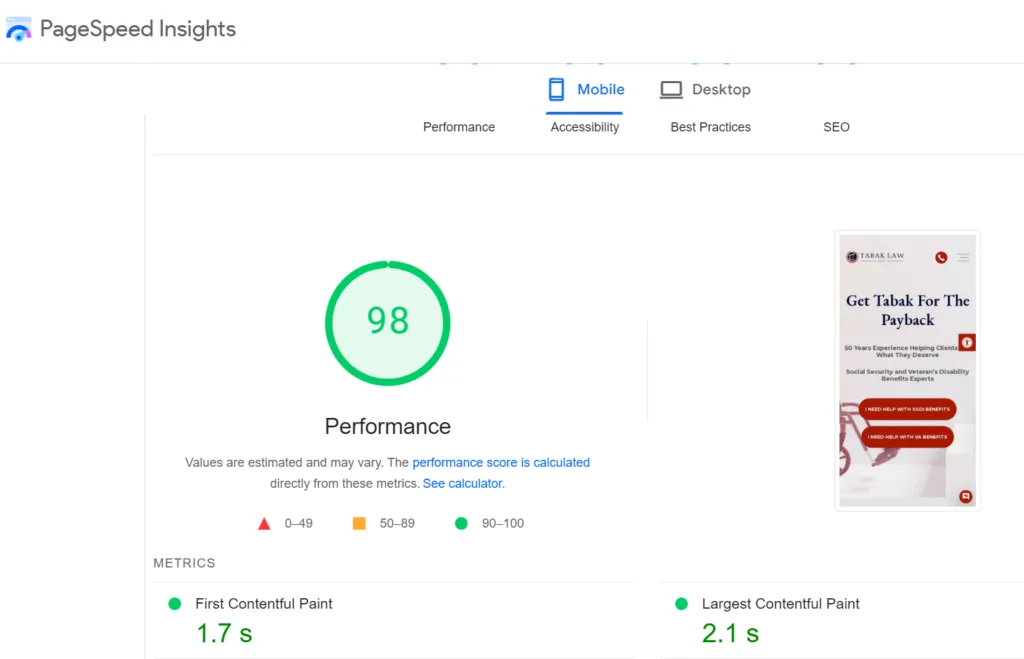
While we are focused on content, we never lose sight of technical performance. An AI model will not recommend a bio page that is slow or broken. High-intent visitors who are looking for a lawyer have no patience for a sluggish experience.
Even as we add these robust sections and high-quality photos, your bio pages must load lightning fast. We build with clean architecture because speed is a trust signal for both people and algorithms. A site that responds instantly tells the visitor that your firm is organized and ready to help.
Law Firm Website Speed: Why it is a Core Ranking Factor
Why This Matters for 2026
In 2026, search engines are looking for individual experts to cite. Your bio is no longer just an about page. It is your primary tool for earning citations in AI Overviews and winning the trust of a skeptical public.
By combining human-centric storytelling with machine-readable data, you create a bio that functions as an authority platform. You prove that you are an expert. You prove that you are real. Most importantly, you prove that you are the best choice for a client in need.
This is exactly what we do at Civille. We do not just build websites. We build authority engines designed for the modern search reality. We ensure your bio is structured for the Knowledge Graph and optimized for the AI answers that are shaping the future of legal marketing.
If you are tired of your attorneys being invisible in search and want to build a team of verified digital experts, it is time to talk to Civille.