
There is a particular kind of search query that tells you everything about where someone is emotionally. “Can I keep my house if I file bankruptcy.” “What happens to my car if I can’t pay.” “How do I stop wage garnishment fast.”
These are not research questions. They are distress signals. The person typing them is not casually browsing their options; they are sitting at a kitchen table at 11 pm, trying to figure out how not to lose everything. And whether your bankruptcy firm shows up in that moment, or your competitor’s does, comes down entirely to your SEO strategy.
This is what makes bankruptcy law one of the most consequential SEO opportunities in the legal space. The intent is high. The urgency is real. And most bankruptcy firms are leaving a significant amount of visibility on the table.
Here is how to fix that.
Understand the Search Journey (It Starts Long Before “Bankruptcy Attorney Near Me”)
Most attorneys focus their SEO on the bottom-funnel keywords, “bankruptcy lawyer in [city],” “Chapter 7 attorney near me,” “file for bankruptcy help.” Those matter, and you absolutely need to rank for them. But the people who search those terms have already made a decision. They know they want an attorney. They are comparing options.
The bigger opportunity, and the less competitive one, is ranking for the searches that happen weeks or months earlier, when someone is just starting to realize they might be in serious trouble.
Think about the questions a person asks before they ever consider calling a lawyer:
- “How many missed payments before foreclosure”
- “What happens if I ignore debt collectors”
- “Can creditors garnish my paycheck in [state]”
- “Is debt consolidation or bankruptcy better”
- “How to stop a lawsuit from a credit card company”
These are mid-funnel, problem-aware searches. The people behind them are financially stressed and actively looking for answers. If your website provides those answers, clearly, helpfully, without burying the information in jargon, you become the trusted resource they eventually turn to when they are ready to take action. You are not just ranking. You are building a relationship with someone before they even know they need you.
A content strategy built around your specific practice area means mapping those questions and creating pages and blog posts that answer them thoroughly. Not thin 300-word pages that technically exist on your site. Real, substantive answers that treat the reader like a human being going through something genuinely difficult.
Local SEO Is Non-Negotiable for Bankruptcy Firms
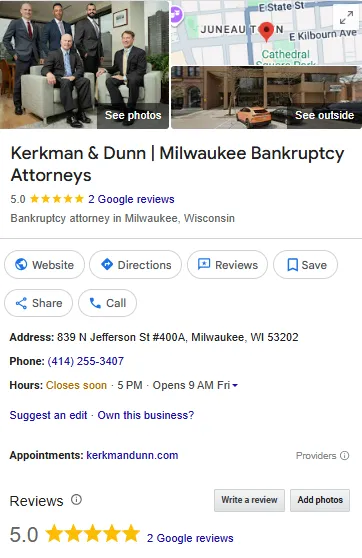
Bankruptcy law is hyper-local. The exemptions vary by state. The trustees and court processes differ by district. A person in Phoenix is not going to hire a firm in Tampa, and Google knows that. When someone searches for bankruptcy help, Google is going to serve them results relevant to their location, and if your local presence is not dialed in, you will not show up regardless of how good your content is.
Your Google Business Profile is the foundation. It needs to be fully built out with the right practice area categories, an accurate service area, updated hours, and a consistent stream of reviews. The firms that dominate the local pack in bankruptcy searches are not necessarily the biggest firms. They are the ones that take their local presence seriously.
Beyond your GBP, the consistency of your name, address, and phone number across legal directories, Avvo, Justia, FindLaw, and your state bar profile signals to Google that you are a legitimate, established business. This is table stakes for local ranking, and a surprising number of firms have inconsistencies that quietly drag their visibility down.
Your Website Has to Load Fast and Convert Clearly
Here is something worth understanding about bankruptcy clients specifically: many of them are searching on a phone, often in a moment of anxiety, and they are not going to wait around for a slow website to load. If your site takes four seconds to be usable on mobile, a significant portion of the people who found you are already gone.
Page speed is a ranking factor, but more importantly it is a conversion factor. A fast, clean, easy-to-navigate website communicates competence before a visitor has read a single word. And for someone who is already stressed about money and skeptical about whether they can even afford a lawyer, that first impression matters more than you might think.
Your homepage and practice area pages should answer three questions immediately: What do you do? Where do you do it? How does someone take the next step? A buried phone number, a vague call-to-action, or a contact form that asks for too much information upfront will lose people who were ready to reach out. Make it easy. Make it obvious.
Free consultation offers convert particularly well in bankruptcy, because the cost concern is almost always part of the hesitation. If that is something your firm offers, it should be front and center, not tucked into a footer.
Content That Meets People Where They Actually Are
The tone of your content matters in bankruptcy more than in almost any other practice area. Personal injury clients are frustrated and motivated. Criminal defense clients are scared but often still in a somewhat defined situation. Bankruptcy clients are often carrying a heavy layer of shame on top of everything else. They have heard the word “bankrupt” used as a social judgment their whole lives, and now they are sitting there wondering if it applies to them.
The law firms that win in this space are the ones whose content acknowledges that reality without dwelling on it. Not performative empathy, actual clarity delivered in a human way. Explaining the difference between Chapter 7 and Chapter 13 without making someone feel like they need a law degree to follow along. Addressing the question “will bankruptcy ruin my life?” honestly, because people are absolutely searching for some version of that.
FAQ-style content performs well for bankruptcy SEO precisely because questions are how people actually search when they are worried. Pages structured around real questions get pulled into featured snippets, AI Overviews, and voice search results. They also build the kind of trust that turns a first-time visitor into a scheduled consultation.
Build Toward the Conversion, Not Just the Click
Getting someone to your site is only half the equation. The other half is what happens when they get there.
Bankruptcy clients are decision-heavy. They are weighing their pride, their finances, their fear of the unknown, and probably the opinions of a spouse or family member who does not want to file. Your website needs to address those objections without the visitor having to ask. That means case result summaries, client testimonials that reflect real situations people recognize themselves in, and clear explanations of what the process actually looks like from intake to discharge.
A live chat or AI chat option can make a real difference here. Someone who is not ready to call but has a quick question about whether their specific situation qualifies — that conversation is often the one that converts. If your site has no way to capture that interaction, you are losing people who were one nudge away from becoming a client.
The combination of strong SEO bringing qualified traffic and a high-converting website doing something useful with it is what actually grows a bankruptcy practice. One without the other is a missed opportunity.
If your firm is ready to show up for the people who need you most, before they hit rock bottom and after, Civille builds the kind of digital presence that makes that happen. From bankruptcy-focused SEO strategy to fast, converting websites, we work exclusively in the legal space because we know it better than anyone else.