Artificial intelligence has officially arrived in the legal world. From drafting memos to summarizing documents, AI is changing how lawyers approach their work.
On paper, this might seem like a dream.
But there’s a growing reality courts are beginning to address. AI cannot always be trusted to be accurate. When mistakes are made in filings, they can carry serious consequences.
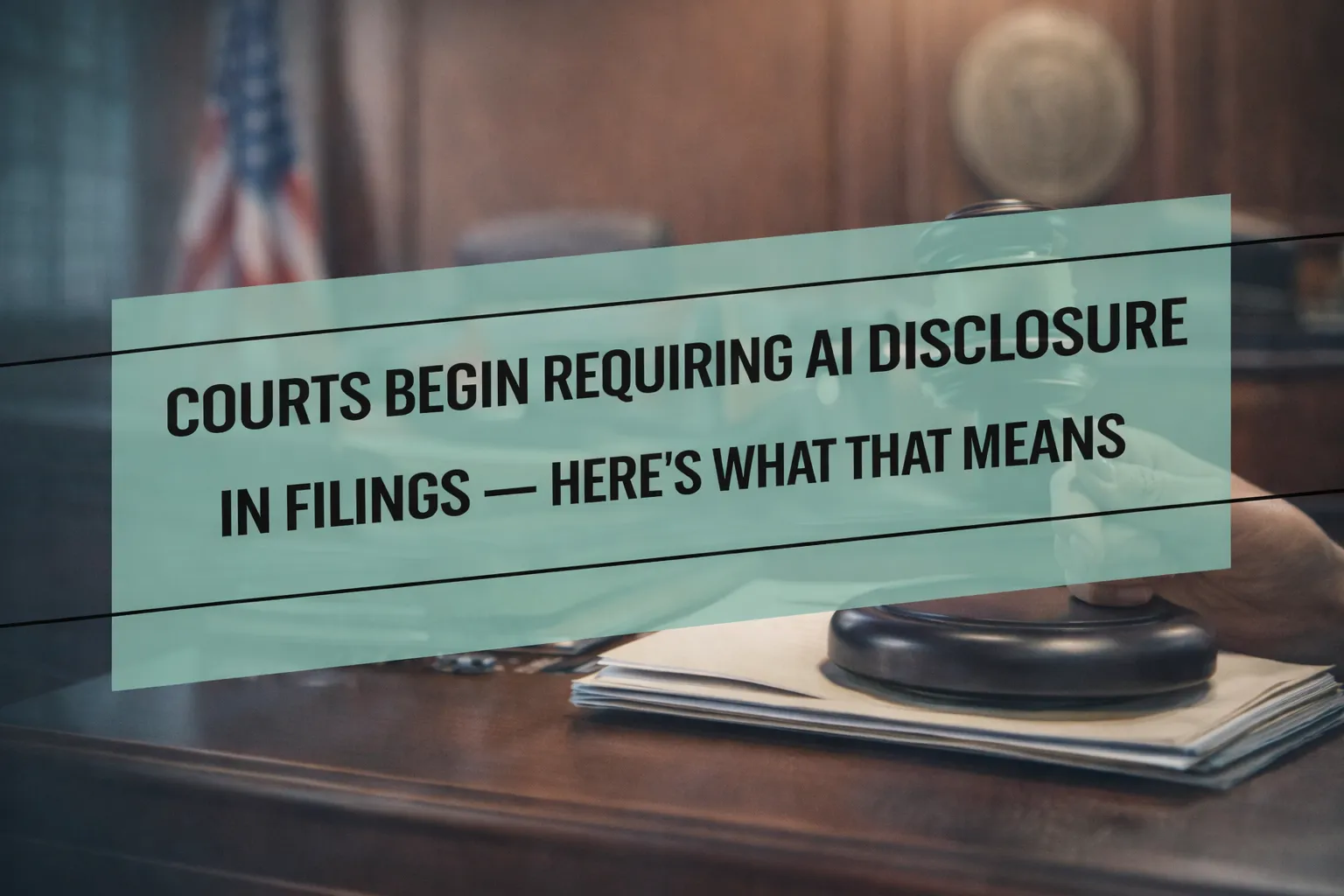
Now, judges across the country are beginning to require AI disclosure in legal filings.
If you are a lawyer, legal assistant, or someone responsible for producing legal content, here is what it means and why it matters.
Courts Are Paying Attention to AI
Generative AI tools work by predicting text patterns. They do not verify facts. These tools create responses that sound correct based on data patterns. While that might not seem like a big deal, it can lead to many problems for legal professionals.
Courts need filings to be accurate and properly sourced. Along with that, they must be grounded in real legal authority. When that standard is not met, the entire process slows down.
AI introduces a new layer of risk. This is not a few typos or formatting errors; these filings include:
- Fabricated case law
- Incorrect legal standards
- Misquoted judicial opinions
These are not harmless mistakes. When this happens, judges and clerks have to stop, investigate, and issue formal orders just to correct the record.
For that reason, courts are taking action. In one notable case, Mata v. Avianca, Inc., attorneys were sanctioned for creating frivolous filings using AI.
Due to these concerns, the Eastern District of Texas has issued its own standing order for AI disclosure.
AI Disclosure Is Becoming Common
While AI disclosure requirements are still evolving, transparency is becoming the expectation, not the exception.
In some courts, attorneys must include a statement confirming whether AI was used in drafting a filing. No, this doesn’t mean listing every prompt or tool used in the creation of the document. However, it does mean acknowledging that AI helped.
Many judges require attorneys to certify that:
- All citations have been independently verified
- Legal arguments are based on real, existing authority
- No AI-generated content has been included without review
In some jurisdictions, courts have taken it one step further. They now require a formal declaration that the attorney, not the AI, takes responsibility for the content.
Courts are making sure that human oversight is still front and center.
Disclosure Boosts Accountability
From the court’s perspective, AI disclosure focuses on accountability.
Judges are not interested in whether a lawyer used AI to help draft a paragraph. They want to know whether the final filing is accurate and grounded in real law.
Without these requirements, courts have no way of knowing if a mistake was a simple oversight or due to unverified AI-generated content.
This matters, especially when it comes time to determine whether sanctions are appropriate.
With disclosure rules, that eliminates any ambiguity. At the end of the day, the attorney is still fully accountable for the final product.
What Are the Stakes for Skipping Disclosure?
Failing to disclose AI use or failing to verify its outputs can lead to serious consequences.
Courts are treating AI-related errors as more than minor mistakes. Depending on the circumstances, attorneys may face:
- Monetary sanctions
- Court orders requiring corrective filings
- Referrals for disciplinary review
- Long-term reputational damage
Even when the mistake is unintentional, the impact can be substantial.
For example, if a lawyer submits a brief with a fabricated citation, the court must assume one of two things: either the attorney failed to verify the source or knowingly submitted inaccurate information. Neither scenario reflects well on the attorney’s professional judgment.
For this reason, disclosure is becoming a protection for both the court and the lawyer.
Lawyers Have to Stay Compliant with AI Use
Whether you like it or not, AI is not going away. Courts are not trying to ban it. But there are new expectations for how it should be used in a responsible manner.
For attorneys, you need to know how to integrate AI safely without compromising accuracy or credibility. Here are some steps to stay compliant:
Verify All Citations
If a case appears in your draft, you should never take it at face value. You should always confirm it in a trusted legal database, such as Westlaw, LexisNexis, or PACER.
AI can produce citations that look legitimate. They even have proper formatting and convincing summaries. Unfortunately, they may be completely fabricated.
Use AI for Structure
AI is excellent at helping you organize ideas and draft outlines. But your legal analysis, conclusions, and citations should always be independently verified. AI can help you get started, but it should never be the final authority on legal reasoning.
Follow All the Rules of the Court
Disclosure requirements vary by jurisdiction. You want to take the time to review the applicable rules for each court before submitting documents. That keeps you compliant and avoid unnecessary follow-up from judges.
Add Verification into Your Workflow
Make sure that all AI-generated data is carefully reviewed before submission. You might want to create a checklist for every filing and:
- Confirm citations and quotations
- Cross-check summaries against the original opinions
- Document your verification process for transparency
When you make verification a part of your workflow, you reduce risk. With these steps, your AI tools can enhance productivity instead of creating new headaches.
Err on the Side of Transparency
If you are unsure whether disclosure is required, you may want to just include it. Transparency is a sign of good faith to the court. In turn, this can reduce the risk of sanctions or ethical challenges.
Even a brief acknowledgment that AI assisted with drafting, with all citations and analysis verified, shows diligence and professionalism.
Keep Your Team Up to Date
AI tools evolve quickly, along with court expectations. When you review updates from local bar associations and ethics committees, that will help your firm stay ahead.
Additionally, you want to make sure all team members understand the proper verification procedures and disclosure requirements. Consistency across your team is important to avoid problems down the road.
Don’t Use AI as a Substitute
Finally, remember that AI is a tool. This is not a replacement for your judgment. Yes, its predictive capabilities are impressive. However, they do not replace critical thinking or ethical responsibility.
Lawyers who use AI for efficiency while maintaining accountability will stay compliant and maintain trust with both the courts and their clients.
AI Problems Can Happen Outside of the Courtroom
AI disclosure is not just a courtroom issue. It also has real implications for legal marketing and content creation. This is an area where many firms are still figuring out how to strike the right balance between efficiency and accuracy.
Law firms regularly publish blog posts, client alerts, FAQs, and website content designed to educate and attract potential clients. While these materials are not filed in court, they still carry weight and authority. For many people, this content is the first impression of a firm’s credibility and expertise.
And at this intersection, things start to get complicated.
If AI-generated content includes inaccurate legal information, it can shape how a potential client sees their legal issue. In some cases, it may even influence whether they decide to contact a firm at all.
Unlike internal drafts or rough notes, published content is public-facing. Once it is live, those blogs and pages reflect on the firm that produced it. Unfortunately, there is no buffer between the message and the audience.
Without protections, AI-generated content can:
- Misinform potential clients: Even small inaccuracies can lead someone to misunderstand the law or their next steps.
- Damage a firm’s reputation: Trust is a major factor in legal marketing. Credibility can be undermined if content appears inconsistent or incorrect.
- Create ethical concerns: Depending on jurisdiction and content type, misleading or unverified legal information can raise professional responsibility issues.
In other words, the same standards that apply in court filings do not disappear when the content shifts to marketing. If anything, they become more important because the audience is larger and less specialized.
Those same principles that lawyers use can also carry over. Accuracy, verification, and oversight matter as much outside the courtroom as they do inside it.
Legal content does not need to be overly complicated or overly cautious. But it does need to be correct. Readers rely on it to make decisions during stressful or uncertain moments in their lives.
In legal marketing, credibility is not just a nice-to-have. It is foundational.
AI in the Legal Marketing World
AI can be a valuable tool. However, it should not change the fundamentals of legal practice. Lawyers are still expected to verify their sources and confirm their citations. Ultimately, they are responsible for the work they produce.
Courts demand AI disclosure because they want transparency and confidence in the filings they review.
That expectation is not going away.
At Civille, that responsibility is taken seriously. Every piece of legal content is carefully researched, reviewed, and verified before publication. We make sure that all content aligns with real legal standards before it ever reaches a client or potential client.
Contact Civille today to learn more about our custom law firm websites and digital marketing services for law firms!