


When a potential client types your law firm name into Google, that search results page is your digital storefront. You don’t just want to be listed on that page. You want a search result that pushes your local competitors out of view, and you want to provide direct pathways to your highest value content immediately.
Those pathways are called Sitelinks. They are the list of indented links that appear underneath your main homepage listing in some Google search results. For a law firm, these links typically point to critical destinations like your attorney bios, your contact page, your reviews, or your primary practice areas.
Sitelinks are not random. They are a sign of digital authority. If your firm does not have them, or if Google is displaying the wrong ones, your search presence is suffering. A poor Sitelink profile indicates that your website is disorganized. It also tells potential clients that finding information on your site might be difficult.
This is your comprehensive guide to understanding how the algorithm chooses these links. We will cover exactly how to earn branded Sitelinks and how to fix a broken or inaccurate Sitelink profile.
Predictions for Law Firm SEO in 2026
Understanding Sitelinks and How They Work
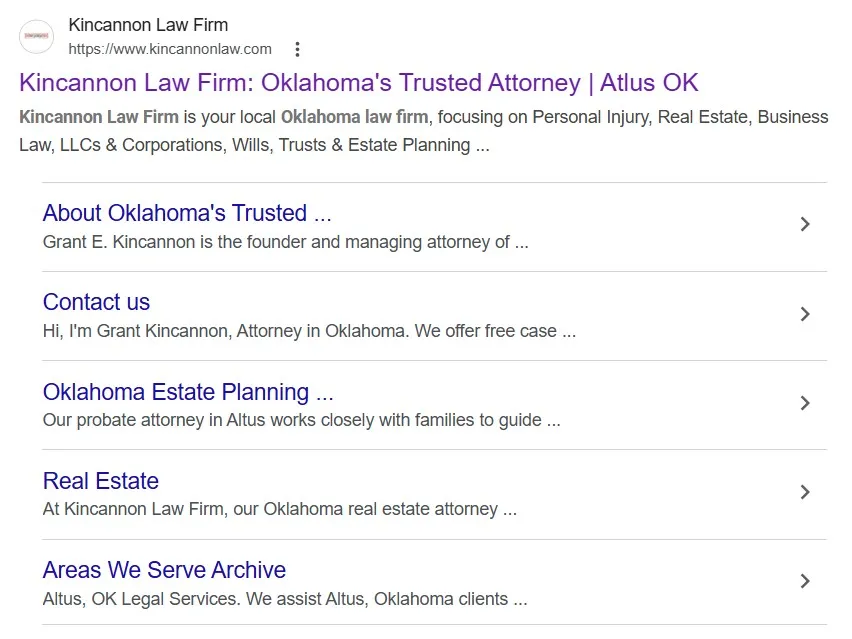
Before we dive into the specific tactics, let’s get one thing straight. You cannot buy organic Sitelinks.
Paid search campaigns on Google Ads allow you to manually create sitelink extensions for your advertisements. Organic Sitelinks operate under completely different rules. They are entirely controlled by Google algorithms. You cannot submit a specific list of links to Google and ask the search engine to display those pages.
Google views Sitelinks as an algorithmic reward, not a guarantee. They are explicitly reserved for results that provide immediate, high-value utility to the searcher. If your site architecture is fragmented or the content fails to align with the specific intent of a query, Google will simply withhold the expanded links, minimizing your presence on the results page.
You have to build a website that forces the algorithm to understand your hierarchy. You must structure your digital presence so clearly that Google has no choice but to prioritize your most important pages.
Why Sitelinks Matter for Law Firms
Earning a robust Sitelink profile provides several massive advantages for your legal marketing strategy. These benefits directly impact your bottom line and your lead generation capabilities.
Maximum Screen Real Estate
A standard search result is relatively small. A search result equipped with a full set of expanded Sitelinks takes up significantly more vertical space. On desktop computers, it dominates the top half of the screen. On mobile devices, this effect is even more pronounced. A result with Sitelinks pushes competitors and legal directories entirely off the first screen. You capture 100% of the visual focus of the searcher.
Frictionless Conversion Pathways
Sitelinks allow users to bypass your homepage entirely. Imagine a user searching for your firm because a friend recommended your car accident services. If you have a Sitelink for Car Accident Lawyer, that user can click directly into the exact content they need. They do not have to load your homepage, find your menu, and navigate to the practice area. Every additional click you require a user to make increases the chance they will bounce off your site. Sitelinks reduce the number of clicks required to convert a visitor into a lead.
Algorithmic Trust Signals
Google only awards Sitelinks to websites with excellent architecture and strong internal linking. Earning them subconsciously signals to users that your firm is established, organized, and authoritative. It presents your firm as a major entity rather than a small and disorganized operation.
Proactive Reputation Management
When someone searches for your brand name, you want to control the narrative. By dominating the search results page with your own Sitelinks, you push down other potential results. This pushes down third-party review sites, news articles, or competitor ads bidding on your brand name. Sitelinks serve as a defensive shield for your brand reputation.
The Anatomy of a Perfect Law Firm Sitelink Profile
What should your Sitelinks actually look like? While you cannot force Google to pick specific pages, you can optimize your site to encourage the selection of high-value targets. A perfect Sitelink profile for a law firm typically includes a mix of trust-building pages and conversion-focused pages.
Ideally, your branded search should yield links to the following types of content.
- Attorney Team or Bio Pages: People hire lawyers, not abstract firms. Users frequently want to read the credentials of the managing partner or the specific attorney who was recommended to them.
- Contact Us: This is often your best conversion link. It gives users immediate access to your phone number, office location, and intake form.
- Core Practice Areas: If you are a personal injury firm, you want a direct link to your auto accident or wrongful death hubs. If you practice family law, you want a link directly to your divorce or child custody pages.
- Case Results or Testimonials: These pages offer immediate social proof. Giving users direct access to your track record helps validate their decision to search for your firm in the first place.
How to Earn Branded Sitelinks
Google awards Sitelinks to sites that are easy to crawl and logically organized. You must organize your digital house to win this real estate. This requires a combination of technical SEO and strategic content planning. Here is your action plan for earning Sitelinks.
Master Your Site Architecture
A flat and confusing website gets ignored by the algorithm. You need a logical and hierarchical structure. Think of your website like a well-organized filing cabinet.
Your homepage is the top drawer. It should link directly to a primary practice areas hub. That hub should then link out to specific services like personal injury or criminal defense. Use clean navigation menus. Do not overwhelm the user with a massive drop-down menu containing fifty different links. Keep your primary navigation focused on the core pages that actually drive revenue and establish authority. If every page on your site is linked from your main menu, Google cannot tell which pages are the most important.
Use Internal Linking
Google follows links to determine page importance. The more internal links a page receives from other pages on your own website, the more important Google assumes that page is.
If you want your attorney team page to become a Sitelink, you must link to it frequently. Create a link to it from your homepage. Link to it from the bottom of your blog posts. Link to it from your individual practice area pages. You must create a web of internal links that all point toward the pages you want Google to feature.
Optimize Your Anchor Text
The clickable text of your internal links matters immensely. This is known as anchor text. Do not use generic phrases like click here or learn more or read our page. These phrases provide zero context to the search engine.
Google relies on anchor text to map your site’s hierarchy. Vague links blind the algorithm. Utilizing descriptive terms like “Contact Us” or “Family Law Services” provides the evidence the search engine needs to promote your most valuable pages. Clarity is the only way to ensure these links claim premium real estate on the results page.
Write Clear Page Titles
Page titles are a primary source for Sitelink text. For SEO, literal accuracy outperforms clever marketing every time. Title a results page “Case Results” rather than “Our Winning Tradition.” When Google’s algorithm can verify the exact utility of a page through its title, it is far more likely to award that page a Sitelink. Avoid ambiguity to secure your search real estate.
Implement Strict Headings
Google doesn’t have the patience to go digging for your main point. You need to give it a single H1 for the headline and use H2s and H3s to lay out the rest. It’s about building a map the crawler can actually follow. When you make it easy for Google to understand your page, it pays you back with better visibility and the kind of Sitelink spots that actually move the needle for your firm.
Submit a Clean XML Sitemap
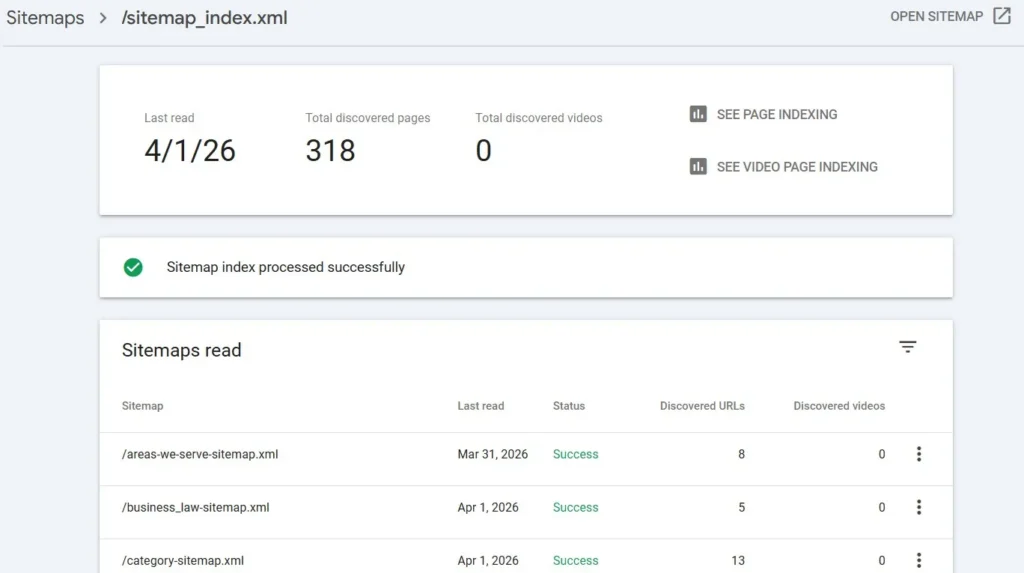
An accurate XML sitemap is a non-negotiable part of your search strategy. It tells Google exactly which pages are your priorities. When you have errors or old redirects in that file, you’re sending mixed signals to the crawlers. Keeping this file clean in Search Console is one of the simplest technical moves you can make to secure those premium Sitelink spots.
Read More: New and Updated Content Boosts Trust and Rankings
How to Fix Missing or Incorrect Sitelinks
Google doesn’t always get it right. It is incredibly frustrating to search for your firm and find a Sitelink pointing to a 2019 privacy policy or an internal employee login page. That is premium search real estate being wasted on content that provides zero value to a potential client. Beyond the missed opportunity, it just looks unmanaged and messy.
Can You Remove Sitelinks Manually?
Years ago, Google offered a Sitelink demotion tool within Google Search Console. It allowed webmasters to manually submit URLs they wanted removed from their Sitelinks. Google removed this feature permanently. You can no longer just click a button to delete an unwanted link. You must fix the root cause on your own website to force the algorithm to update.
Diagnose the Internal Link Problem
If an unwanted page is showing up as a Sitelink, Google thinks it is highly important. Why does Google think it is important? Usually, it is because you are linking to it far too often.
Check your website footer and your sidebar. If you have a link to a low-value page in your footer, that link appears on every single page of your entire website. Google sees thousands of internal links pointing to your privacy policy and assumes it must be a critical page. Remove links to low-value pages from your global navigation. Move them to less prominent areas of the site.
Utilize the Noindex Tag
A noindex tag is the kill switch for unwanted Sitelinks. Use this on pages like employee logins or internal documentation that offer no utility to the general public. By de-indexing these pages, you prevent the algorithm from ever selecting them as Sitelinks, ensuring only your most relevant pages occupy that premium search real estate. Only do this for pages you don’t want to show in search at all.
Update Outdated Content
Sometimes a Sitelink points to a blog post that was very popular three years ago. If you cannot remove the link, you should optimize the page. Update the content to reflect current laws. Add fresh internal links pointing from that old post to your current and high-value practice area pages. Turn that unwanted Sitelink into a funnel that directs users back to the pages you actually want them to see.
Force a Recrawl via Search Console
Don’t leave your search presence to chance. Once your menus and noindex tags are live, go straight to Search Console. Use the URL Inspection tool on your homepage to signal that your structure has changed. This prompts an immediate re-crawl, forcing the algorithm to parse your new hierarchy rather than relying on old data. It’s the final, necessary step to ensure those irrelevant Sitelinks drop off and make room for your high-priority content.
The Role of Technical Performance
Think of site speed as a prerequisite for premium search real estate. Google focuses entirely on the user, so a slow page is a liability, not a Sitelink candidate. Clean architecture gets you halfway there, but you have to finish the job with technical optimization. Properly compressed images and high-quality hosting aren’t just nice-to-haves. They are signals of quality. When a page is fast and responsive, Google feels much more comfortable recommending it as a primary entry point for your business.
The Connection to AI Search
As search moves toward an AI-driven landscape, Sitelinks remain a vital trust signal. Generative AI models often pull information from the pages that Google has already identified as being authoritative within your site structure.
By organizing your site to win Sitelinks, you are also organizing your site for AI visibility. You are making it easy for an AI model to understand who your lawyers are and what your firm stands for. This structural clarity is exactly what the modern searcher expects. It is also exactly what the latest algorithms require.
Building the Ultimate Digital Entity
Earning Sitelinks requires technical precision and logical organization. You are building a digital entity that both humans and machines can navigate flawlessly.
When you optimize your site architecture, clarify your titles, and strengthen your internal linking, you do more than just clean up your search results. You build a foundation for long-term SEO dominance. These technical improvements make your site faster, easier to read, and more authoritative in the eyes of the latest search models.
A well-structured site is exactly what generative answer engines look for when deciding which law firm to recommend. It is also exactly what a stressed and high-intent client looks for when they need immediate legal help.
Your search results should reflect the quality of your practice. By fixing your site hierarchy and earning your Sitelinks, you take back control of your brand’s first impression. If you’re ready to move past a fragmented online presence and build a foundation that commands respect, it is time to connect with Civille.