For decades, the math of Paid Search (PPC) was simple. It was a linear auction.
You paid for the top position. You monitored your average position metric. If you were #1, you were the first thing a potential client saw. You were the king of the hill. If you were #4, you were at the bottom. The rules were clear, and the real estate was static.
In late 2025, the rules have broken. You can now be the king of the hill, pay premium rates for the #1 spot, and still be completely invisible to the user.
A massive shift is happening on the Search Engine Results Page (SERP). It isn’t just affecting your organic traffic. It is aggressively cannibalizing your paid ads. Google’s AI Overviews, those large, colorful, auto-generated answers at the top of the page, are physically pushing your ads off the screen.
New data reveals a stark, uncomfortable reality: On many high-value legal searches, the top ad position is now visually located below the fold, buried under a mountain of AI text, citations, and dropdowns.
If you are still running your PPC campaigns like it’s 2023, relying on simple impression share metrics, you are likely paying premium prices for bargain-bin visibility.
The New Anatomy of the Search Page
To understand the severity of the problem, we have to stop thinking in terms of rankings and start thinking in terms of pixels.
In the past, the above-the-fold area (the part of the screen visible without scrolling) was roughly 800-1000 pixels high on a desktop, and ads took up the top 150 pixels. The first organic listings started at pixel 200. Visibility was guaranteed.
The New World is crowded. When an AI Overview triggers, it is not a small snippet. It is a dynamic, expanding module. It includes:
- The Generative Summary: A paragraph of text answering the user’s question.
- The Citation Carousel: Cards with images and links to sources.
- Follow-Up Questions: Buttons that expand the answer further.
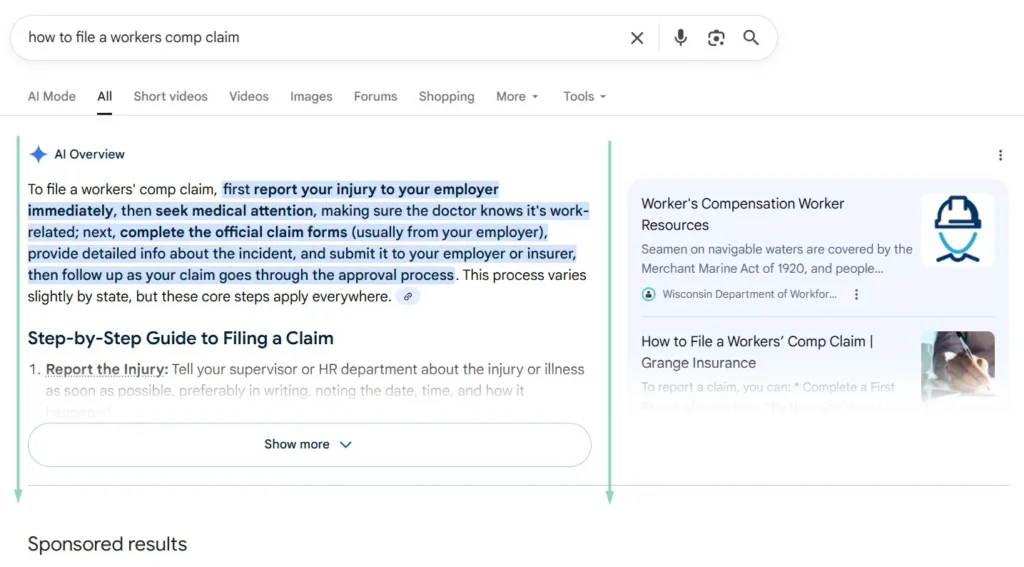
On a standard laptop screen, the AI Overview alone can consume 600 to 800 pixels of vertical height.
Now, add the sponsored label. Add the Local Services Ads (LSAs) ribbon that often sits above the AI. By the time the browser renders your top-of-page text ad, it might be starting at pixel 1,200.
This means that though your ad is first, it is functionally on page 2. The user has to actively decide to scroll past a highly engaging, colorful AI answer just to see your headline.
The Data: 25% of Ad Visibility Is Gone
This isn’t just an anecdotal theory. It is a measurable trend.
A recent comprehensive study by Adthena, reported in Search Engine Land, quantified exactly what legal marketers have been fearing. They analyzed millions of search results across various industries to measure the AI Impact.
The findings were stark: When an AI Overview triggers, ad visibility is lost 25% of the time.
Let’s break down what lost visibility means. It doesn’t mean your ad wasn’t served. You still entered the auction. You might have even won the bid. But the user never saw you. They engaged with the AI content or clicked a citation link within the overview, and your impression was wasted.
For law firms, where Cost-Per-Click (CPC) can already be expensive, and getting a conversion can easily exceed $50 or $100. Wasted impressions are a financial bleed you cannot afford. You are effectively paying a visibility tax to Google for the privilege of being buried by their own technology.
The Mobile Squeeze Is Critical for Lawyers
This problem is compounded on mobile devices. Consider your own user behavior. When you are on your phone, you are in scroll mode. But you are also impatient. When a user on an iPhone types “What to do after a car accident,” the AI Overview takes up the entire vertical screen. It is 100% of the viewport.
The user has to scroll past the summary, past the People Also Ask box, and past the map pack. In this mobile environment, text ads are often pushed so far down that they become an afterthought.
The data shows that mobile devices magnify the visibility loss. In complex industries like automotive, finance, and legal, mobile ads are pushed below the AI Overview nearly 50% of the time.
If 60% of your traffic is mobile (which is standard for personal injury and criminal defense firms), and 50% of those users have to scroll to see your ad, you have a massive efficiency leak in your budget. You are bidding on mobile traffic that is effectively blind to your existence.
Surviving the AI Squeeze: How Law Firms Win When Clicks Drop
The Intent Filter: Where to Fight and Where to Fold
So, is PPC dead? Absolutely not. Paid Search remains the fastest way to acquire a client. But the strategy has to change. You have to stop fighting battles you can’t win and focus on the ones where you have the advantage.
The key to surviving the Invisible Ad War is rigorous Intent Segmentation.
The AI Overview is aggressive on Informational Queries.
- Query: “Statute of limitations for slip and fall in Texas.”
- Query: “How much does a divorce cost in Florida?”
- The Result: Google’s AI is confident it can answer this. It triggers a massive overview. Ads are buried.
- The Strategy: Fold. Stop bidding aggressively on these “definition” keywords. The user is looking for an answer, not a lawyer. The AI provides the answer. Your ad is irrelevant clutter.
However, the AI Overview is often absent or significantly smaller on commercial/transactional queries.
- Query: “Hire slip and fall lawyer Dallas.”
- Query: “Best divorce attorney near me.”
- The Result: The AI steps back. Google knows this is a “shopping” query. It wants to show ads because that is where the revenue is. Ads are front and center.
- The Strategy: Fight. Pour your budget here.
The mistake most firms make is treating all keywords equally. In 2026, you must segregate your campaigns. You cannot afford to pay transaction prices for information searches that are being dominated by AI.
Tactical Defense #1: The Negative Keyword Firewall
How do you execute this fold strategy? You build a firewall using Negative Keywords.
In the past, negative keywords were used to block irrelevant traffic (like free, job, or cheap). Now, you must use them to block AI-Triggering Intent.
You should actively exclude the research phrases that are most likely to spawn an AI Overview that hides your ad.
The “Anti-AI” Negative List: Add these terms to your high-intent campaigns as negatives:
- “What is”
- “How to”
- “Definition of”
- “Statute”
- “Can I”
- “Does”
- “History of”
By stripping these words out of your campaign, you force Google to show your ads only on the query strings that are lean, direct, and transactional. These are the exact queries where the AI stays out of the way.
Tactical Defense #2: The LSA Super-Weapon
If there is one clear winner in this new landscape, it is Local Services Ads (LSAs), the ones with the “Google Screened” badge and the headshots.
Why? Because Google has architected the page to protect them.
In almost every variation of the AI-integrated search page, the LSA ribbon appears above the AI Overview. It is the only ad format that consistently defies the pushdown.
- Trust Signal: Google knows users trust these verified profiles more than text ads.
- The Human Element: In a page full of AI-generated text, the LSA headshot stands out as a real person.
The Action Plan: If you have been treating LSAs as a set it and forget it channel, you need to wake up. This is now your prime real estate.
- Review Velocity: Ranking in the LSA ribbon is heavily dependent on recent reviews. You cannot coast on reviews from 2024.
- Response Time: The algorithm punishes firms that miss calls. If you don’t answer the LSA line, you drop out of the top 3 ribbon and into the more menu, which is essentially invisible.
- Budget Uncapping: Since this is the only safe space above the fold, consider shifting budget from traditional text ads to maximize your LSA impression share.
Tactical Defense #3: The Brand Defense Paradox
There is a counter-intuitive twist to this war. You might think, “If organic is buried, I rely on my brand.”
But what happens when someone Googles your firm’s name directly?
- Query: “Smith Law Group.”
In the past, your website was #1 organic. No problem. Today, an AI Overview might pop up to summarize your firm: “Smith Law Group is a personal injury firm located in…”
Here is the danger: Competitors can bid on your brand name. If a competitor is bidding on “Smith Law Group,” and the AI Overview pushes your organic listing down, the competitor’s ad might be the only clickable link above the fold.
A user searching for you sees the AI summary, and then immediately sees a button to call your competitor.
The Strategy: You must run a brand defense campaign. You have to bid on your own name. Yes, it feels like paying for traffic you should get for free. But in the invisible ad war, paying for your own brand name ensures that your ad sits at the very top, insulating you from the AI push-down and competitor poaching.
Tactical Defense #4: Ad Copy Must Be Anti-AI
Finally, if your ad does appear below the AI, you have to accept a hard truth: The user has already read the answer.
If the user searched “What to do after a crash,” the AI has already given them a checklist: 1. Call police, 2. Take photos, 3. See a doctor.
If your ad headline says: “Car Accident? Here is what to do,” you are redundant. You are offering information they just consumed. They will scroll past you.
You must pivot your ad copy from Information to Action.
The “Anti-AI” Copy Framework:
- Don’t Define: The AI defined it.
- Don’t Explain: The AI explained it.
- Do Offer: A specific, human value add.
You have to be the actionable next step that the AI couldn’t provide. The AI gives the what, you sell the how.
Read More: A Practical Guide to Building Your Law Firm’s AI Trust Signals
The Silver Lining: Higher Quality Leads
There is good news in this data. It isn’t all doom and gloom. While overall click volume might drop because of the AI interference, early data suggests the quality of the remaining clicks is increasing.
Think about the user journey.
- A user searches.
- They read the AI Overview. They get educated.
- They realize, “Wow, this is complicated. There are deadlines. There is liability. I can’t do this myself.”
- Then they scroll down and click your ad.
That user is not a tire kicker. They are not looking for a definition. They are educated, validated, scared, and they are also ready to hire.
It isn’t about getting more clicks anymore. It’s about getting the right clicks. It’s about accepting that you will lose the curiosity traffic to the AI, and positioning your ads to capture the commitment traffic that follows.
How Civille Fights the War for You
Most agencies are still reporting on average position and pretending nothing has changed. They are happy to spend your budget on informational clicks that never convert.
At Civille, we don’t just set your ads and forget them. We monitor the visual reality of the search results.
- We use negative keyword firewalls to protect your budget from AI waste.
- We optimize your LSAs to ensure you stay above the fold.
- We write ad copy that compels users to act.
The screen is getting smaller. The competition is getting smarter. If you want a partner who watches the pixels, not just the spreadsheets, it’s time to talk to Civille.